
Fruit Chutney with Greek Yogurt
September 28, 2009 by The swedish meatball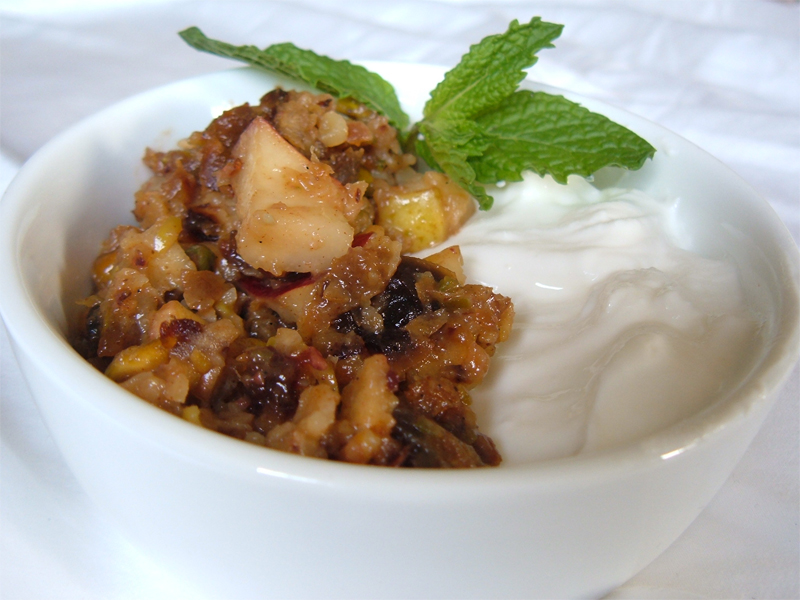
I was browsing Gourmet Magazine online when I saw this recipe for haroseth. Not being Jewish, I have never tasted haroseth, but the ingredients set my mind wanderingwhat could I create with fruit and nuts?
To say I love fruit is a massive understatement. Earnest devotee would be a more accurate description, as would obsessed addict. This summer I absolutely went wild over the fresh peaches, nectarines, and cherries; for the latter, we actually took a 145 mile round-trip to Leona Valley to hand-pick a few buckets of fruit. There were no leftovers.
But because I love my fruits so well and because my nutritional needs must be balanced, I am extremely picky about how I consume fruit and what kind of fruit I consume.
Anything short of absolutely fresh, ripe, and juicy is eyed with skepticism. At times I have even regarded cooking fruit on par with defiling sacred grounds or (if the fruit was bad) dressing up a poor ingredient in fancy clothes. These well meaning but sometimes severe opinions have held me back from experimenting much with fruit outside the arena of pies, jams, and pastries.
The last several years have forced me to reconsider my aversion to fruit experimentation. Poultry with fruit-sausage stuffing, fruit glazes on roasts, caramelized nectarines with red onions, and an unusual Turkish dessert of pear stuffed with honey-sweetened granola topped with a honeydew melon dressing: these are among the few interesting uses of fruit I have seen, and they have gradually convinced me of fruit’s versatility in cuisines of all sorts.
So today was another day of brainstorming for the hitherto (mostly) virgin territory of fruit experimentation. As experiments go, this one was pretty simplea dessert. I thought back to what I knew of the flavors associated with Greece, the Middle East, and India: honey and thick yogurt instantly came to mind from the classic Greek dessert Yiaourti me meli; from the Middle East, I remembered figs and pistachios; green cardamom seeds, cinnamon, and peppercorns were inspired by masala chai from the Indian subcontinent. NB: do not confuse green cardamom with black cardamom, as the flavors are very distinctive. Very important!
The result is a spiced, thick fruit chutney. Here’s my procedure, which makes three to four quarts:
3 Fuji Apples
3 Bartlett Pears
2 D’Anjou Pears
Unsweetened Dates from Blackwell’s Corner
Dried Unsweetened Apricots
Pistachios
Walnuts
Wildflower Honey
Apple Cider Vinegar
Vanilla Bean
Powdered Ginger
Green Cardamom Pods
Black Peppercorns, ground
Ceylon Cinnamon Sticks
- Shell the pistachios. Place them in the food processor and pulse until the nuts are coarsely chopped. Remove these pistachios to a very large bowl.
- Pulse the walnuts in the food processor until their texture is very similar to the pistachios. Remove the walnuts to the bowl with the pistachios. NB: Do this step separately from the pistachios because these two nuts will achieve the right texture at different times. Processing them together will result in over or under processed ingredients.
- Wash and core the apples, then chop into one inch chunks. Place these chunks in the food processor and pulse until the fruit is finely chopped, but not pureed. Remove the apple to the bowl with the nuts.
- Process the dates and the apricots separately until they achieve the desired texture, then remove them to the bowl with the other ingredients. Stir.
- Wash and core the pears, then chop into quarter inch chunks. Do not process them in the food processor. Toss the pear with the other ingredients in the bowl, but do not over-mix.
- To a large stockpot over medium-high heat, add enough apple cider vinegar to cover the bottom, honey to taste, pepper, green cardamom seed pods, ginger, and cinnamon sticks broken in two.
- Scrape out the vanilla bean's contents and add to the stockpot. Save the bean husk and use it elsewhere or place it in the pot.
- Simmer the contents of the pot for at least 10-20 minutes, stirring every minute or so. If necessary, add extra water or apple cider vinegar.
- Using a slotted spoon, remove the cardamom seed pods and the vanilla bean husk. Turn off the heat. Quickly add the fruit and nut mixture to the stockpot. Remove the cardamom seeds from their pods and add to the stockpot (optional). Stir and serve with Greek yogurt.
Experimental suggestions for next time:
- Remove the cardamom seeds from their pods before adding them to the stockpot in Step 6. It wasn't difficult to remove the pods using the slotted spoon, but it was somewhat bothersome and could be avoided. Also, the cardamom flavor could be stronger.
- I did have some difficulty obtaining the right texture for the pistachios. Half the pistachios finished while the others remained in large chunks. Next time, try pulsing in smaller batches.
- Use fresh ginger instead of powdered.
- Simmer the contents of the pot for 30 minutes in Step 8 for a more well developed flavor.
- Try adding other spices: star anise, cloves, allspice, or some kind of black tea. The recipe is very versatile and will support many variations.
- Try pairing the fruit chutney with cheese or cheese and crackers instead of yogurt.