
Simple Roasted Leg of Lamb
September 28, 2009 by The swedish meatball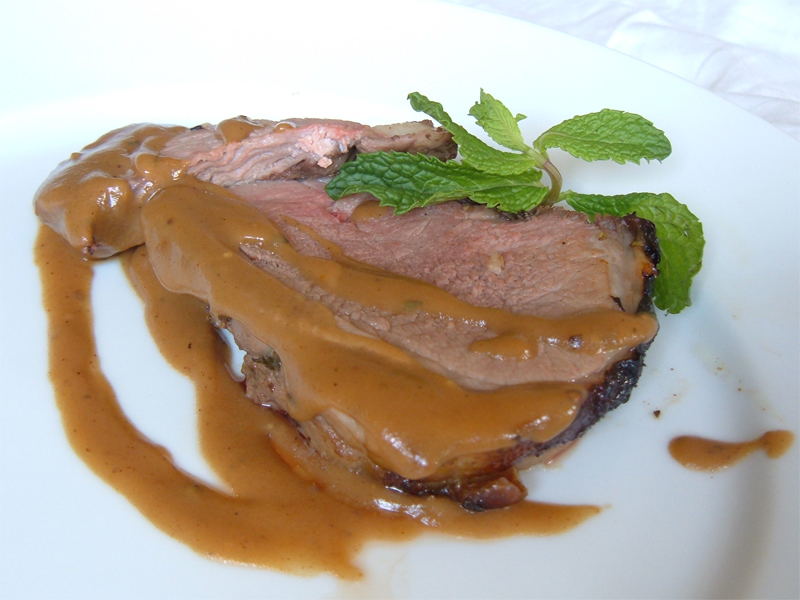
Meat, in terms of both quality and variety, is an unfortunate casualty of the modern grocery mega-mart and the demand for cheap. Unless you know a good butcher or shop at a higher-end chain store, certain cuts or types of meat are virtually impossible to obtain. Don’t believe me? Try buying fresh rabbit for an authentic paella. In Los Angeles county you can supposedly buy rabbit from Bristol Farms, but the prices at said store are very steep and cater to the wealthy rather than the everyday cook. What about fresh (not frozen) cornish hens? Or more esoteric ingredients, like goose liver or sheep’s stomach? Good luck.
Don’t even get me started on the meat and seafood section of our neighborhood Albertsons. Sometimes it’s just plain gross: holes in the packaging, gray meat, and terrible cuts full of more tissue and fat than actual substance. Other times I just get lost in the shelves of chicken breast, thighs, and drumsticks; what little variety they have is a waste of money and time in the kitchen. The quality is pretty close to awful.
Why are grocery chains such bad butchers? The truth is it’s cheaper to mass produce a few animals and use the tricks of industry to feed, fatten, and slaughtertaking only the cuts in high demand. Consider the cow, for instance. In concentrated animal feeding operations, we feed cows a diet of U.S. corn, antibiotics, chicken feces and feathers. The corn and the feces make the cows sick, so we administer drugs and slaughter them before they can die; packing the cows together produces very disgusting, unsanitary conditions full of animal waste, so we use pesticides to control disease. Pesticides and antibiotics in turn pollute our environment and create pathogens resistant to treatment. All of these efforts, however, produce the greatest profit-to-expense ratio. That’s how you buy your steak for $3.99/lb rather than $6.99/lb.
NB: Michael Pollan has written extensively on the high cost of our fast-food society; you can read a transcript of his interview on NPR for a more in-depth look at your beef.
Given all this information, when I want good meat, you can perhaps understand why I wind up at places like Whole Foods or Bristol Farms anyway. I’m lucky enough to be able to afford the expense, but I don’t do it because I like to, but rather because there’s not really a choice. Where else can I purchase a fresh, whole boneless leg of lamb that isn’t 40% fat and 60% meat? Point the way, please.
This recipe is a very simple, very traditional way to roast lamb in the oven. You could use a fruit glaze instead, but stronger ingredients tend to mask the natural flavor of lamb—which, in my opinion, is a good reason to be conservative when selecting a marinade or sauce for this somewhat special meat. Both the marinade and the sauce should complement the lamb, but allow its uniqueness to shine through. I don’t want to eat a slice of sauce.
I caution you against using kosher salt and a meat thermometer is mandatory, but otherwise the instructions are short and easy. Be sure to read the suggested modifications to the recipe, below the procedure.
4.2 lbs boneless leg of lamb, washed and patted dry
fresh mint, chopped
fresh oregano, chopped
fresh rosemary, chopped
honey
lemon juice
olive oil
salt
black peppercorns, ground
Penzey’s Lamb Seasoning
¼ cups butter
a little less than ½ cups all purpose flour
homemade chicken stock
¼-½ cups cream
nonfat milk
- Place the leg in a large zip bag. Add the fresh herbs, honey, lemon juice, olive oil, salt, pepper, and Penzey's seasoning to the bag. Force out the air in the bag and close the top. Then turn and shake the bag until the roast is thoroughly covered in the marinade. Place the bag in the fridge for several hours or overnight.
- Preheat the oven to 400°F.
- Place the leg fat-side-up in a casserole pan completely covered with heavy duty aluminum foil. Allow the leg to reach room temperature. NB: There should be no holes in the foil, and the foil should not be tightly crimped to the sides of the pan. Later you will need to be able to easily remove the foil.
- Roast the leg of lamb in the oven for 20-30 minutes. Then reduce the temperature to 300°F and roast for an additional hour or until the lamb reaches an internal temperature of 150°F. Remove the lamb from the oven and transfer to a cutting board. Let the lamb rest 10 minutes before slicing.
- Gently shape a spout for the foil, then lift and pour the pan juices into a container where you can easily separate the fat from the meat drippings.
- Prepare a white or blond roux using flour and butter. Then slowly add the meat drippings to the pan, whisking constantly to achieve a smooth texture. Add a little cream and nonfat milk for extra richness, if desired. Season with salt, pepper, and extra herbs. Serve in a gravy boat.
- Roast the lamb to an internal temperature of 140-145°F. The lamb was barely pink at 150°F and still tender (which is the way my husband prefers most meat right now), but I think the optimal temperature is somewhat lower. Maybe I can convince Tyler to see my way on this one ;)
- For variation, prepare an au jus instead of a gravy. Usually I prefer gravy, but with lamb I'm guessing the au jus would probably be better.