
Stock Basics and Fish Stock
October 6, 2009 by The swedish meatballNo kitchen can truly be great without homemade stock. Stock is the fonds de cuisine, or "the foundation of cooking," and is a major component of rich stews and many excellent sauces. (And as for sauces—well, no aspiring chef or gourmet cook can truly claim fame in the culinary arena without demonstrating command of sauces.) Furthermore, a properly prepared stock made from scratch will always outperform prepackaged stock from the supermarket or stock made from powders; the two cannot even compare. If you haven’t already, do yourself a favor and upgrade your kitchen with a little homemade stock. Prepare stock the night before and refrigerate or make in advance and freeze for up-to several months.
There are at least a dozen, if not several dozen, variations of stock, depending on the ingredients and the methods employed. However, we can usually break down a traditional stock into three basic components:
- Meat and/or bones cut into pieces, usually three inches long, to maximize flavor extraction.
- Mirepoix. The mirepoix is a mixture of finely chopped roots and vegetables which, together with the meat and bones, forms the flavor base of the stock. A mirepoix can contain bell peppers, onion, mushrooms, leeks, celery, parsnips, onion, and shallots among other things, but the classic mirepoix is a combination of onion, celery, and carrots in a 2:1:1 ratio by weight. With the exception of fish stocks and court bouillons, mirepoix should be added two hours before finishing the stock. Cut size varies with the length of time on the stove, so use a ½ inch dice for one hour and smaller or larger dices for shorter or longer simmering, respectively. (The Professional Chef, Culinary Institute of America.)
- Sachet d'Épices, often just called a sachet. The sachet is a cheesecloth bag containing spices and herbs used to impart additional flavor, and is usually added in the last 30 to 45 minutes of simmering for peak flavor. The bag can be removed with a slotted spoon or by pulling up on an attached piece of twine.
Note that there are exceptions to this breakdown, especially outside French-influenced European cuisine—for example, dashi. However, the most common stocks in today’s recipes (chicken, beef, and fish) are all described by these ingredients. Beyond what goes into a stock, there are also a few general rules to observe when making a clear, tasty stock free of dirty grime and the impurities which inhibit long-term shelf life.
- Begin the stock with cold water, not warm or hot. Starting slowly will allow the impurities to coagulate properly and rise to the surface where they can then be removed.
- Simmer your stock gently. Vigorous boiling will circulate the impurities, resulting in a cloudy stock. NB: Personally, I have never had any problems with cloudy stock when just barely bringing the ingredients to a boil and then reducing to a simmer. However, the Culinary Institute, which tests such subjects much more thoroughly than yours truly, emphatically insists that stock should never be boiled at any time. They say bubbles should break the surface infrequently, reflecting the action of the French verb frémir, "to tremble."
- Skim off impurities and remove any congealed fat from the stock as needed.
- Try to use a stockpot made of a non-reactive surface like stainless steel. Occasionally, the ingredients in stock will react with the pot, creating undesired discoloration.
- Cool the stock quickly in a metal container. Cooling quickly will prevent your stock from becoming a bacteria culture. The best way to do this is to transfer your stockpot to a rack submerged in an icewater bath and wait until the stock reaches a temperature of 40°F. NB: The rack will allow water to circulate underneath the pot.
- Unless you are "dry-sweating" ingredients prior to adding liquid, you should never cover your stockpot with a lid while the stock is still warm. I have heard the occasional dire tale of warm stocks souring (quite literally) when covered. I'm not exactly sure what the mechanism is, but why would you want to cover your stockpot anyway? Covering increases the temperature of the stock, but at the expense of visibility and access to the pot.
- If you salt your stock, be very careful. Any salt you add now is salt you can't take away later when you use the stock as an ingredient in other recipes. Be conservative.
Of the three categories of stock recognized by the Culinary Institute of America, white, brown, and fumet, fish stock is technically a white stock. The bones and/or meat swim in cold water immediately after being rinsed and trimmed. (Fumet ingredients are sweated beforehand and brown stock ingredients are browned.) Quite frequently, however, recipes and their authors will not distinguish between a fish stock and a fish fumet. But a fumet is more pungent than fish stock and contains more acidic ingredients, like wine and lemon juice. Both fish stock and fumet are made with the bones, sometimes the heads, of lean fish like halibut and sole. Avoid fatty fish like salmon, and clean the parts of gills, scales, excess blood, and organs.
For fun, let’s compare the ingredients of several recipes for "fish stock:"
| Food : Water : Wine* | Onion | Celery | Carrot | Bay Leaf | Parsley | Thyme | Garlic | Mushrooms | Other | |
| Food Network | 1.00 : 0.50 : 0.13 | X | X | X | X | X | X | X | O | none |
| Gumbo Pages | 1.00 : 0.67 : 0.17 | X | X | O | X | X | O | X | X | parsnips |
| Food & Wine | 1.00 : 0.75 : 0.50 | X | X | O | X | O | O | X | O | leek |
| Chow | 1.00 : 1.00 : 0.25 | X | X | X | X | X | X | X | O | none | Cook Gourmet | 1.00 : 0.50 : 0 | X | X | X | X | X | X | O | X | none |
*lbs : quarts : cups
If you define a fumet as fish stock with the addition of wine, technically 4 out of 5 of the recipes above are fumets and not fish stocks. But, as MarxFoods and Cook Gourmet note (and as we discussed previously), a good fumet has other distinct characteristics aside from the addition of a little wine.
Take note of the ratio of fish to water to wine in these recipes. Dilution ranges from 0.5x to 1.0x, while wine content varies from 0 to 0.5x! That’s quite a load of difference. What do we use? Logically speaking, I would say use what makes sense. The stock is only going to simmer for 30-40 minutes, so most of whatever water we add will remain in the pot. Conclusion: use less water if you want a more concentrated flavor. (I recommend this anyway because you can always dilute a stock, but boiling down a stock after the fact is more work and can break down the flavors.) And as for the wine? A dry white wine will add depth of flavor and acidity. Personally, I would add the wine for the flavor, but keep the relative content low to avoid over-acidity. Again, you can always add more wine to the dish after the fact. If you’re just that intent on the extra acid, however, what you may really want is a fumet. Consider all your options before going forward. NB: As it turns out, my recommendations also agree with the advice of the folks at the Culinary Institute.
The choice of mirepoix and sachet is a little more straightforward. Of the three recipes with the characteristics I described above (Food Network, Gumbo Pages, and Cook Gourmet), the Gumbo Pages recipe is tailored for creole and cajun food, so if that’s where you’re headed, great! Use those ingredients. But if, like me, you’re looking for something that can be used in Italian or French food, I would stick with recipes more like those of Food Network and Cook Gourmet. The inclusion of mushrooms and garlic are optional. Garlic adds great flavor, but can be very powerful if used in excess; in stock, you really don’t want the garlic to detract from the potency of the fish, which is really the central ingredient here. Mushrooms are also tasty, but can be easily overwhelmed if not used in mild or creamy sauces. Leeks and fennel are also perfectly acceptable additions. Take into consideration what the stock will be used for before selecting ingredients.
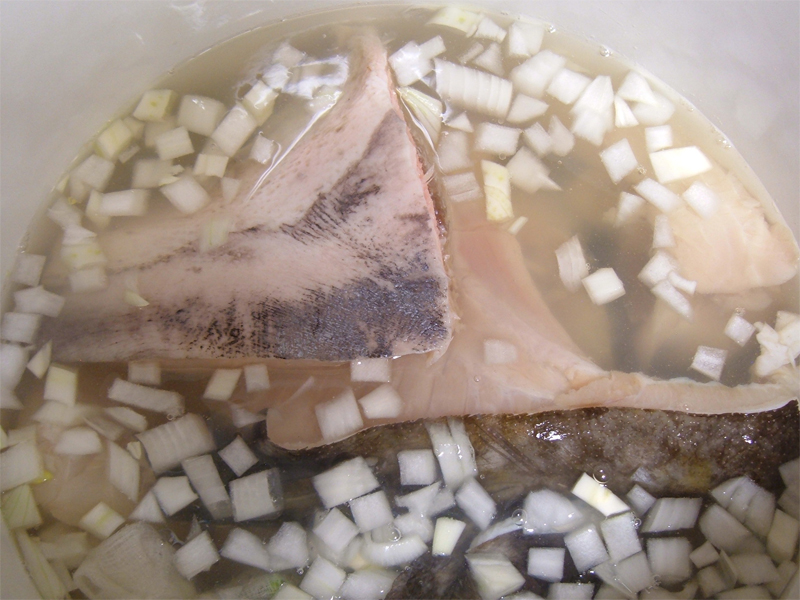
Ingredients
5.5 lbs fish bones and chuck
9.5 cups cool water
½ + ⅛ cups white wine
114g white onion
57g celery
57g carrots
20g fennel
1 bay leafs
a small bunch of parsley stems
sprigs fresh thyme
1 clove garlic
a few grinds of the peppermill on a very coarse setting
- Wash all fish parts of blood, trim tissue if necessary, and discard any fins. NB: Whole fish frames are a bit hard to come by, but Quality Seafood in Redondo Beach sold us a 5.5 lb bag of a leftover halibut, which included bones and unusable meat sections. Total cost was about $6.
- Assemble the sachet. Cut a rectangular piece of cheesecloth to size, spread it out on a flat surface, and place the herbs and spices on top. Draw the edges of the cheesecloth together and secure with a long piece of kitchen twine; leave about a foot of excess twine so you can pull the sachet out of the stockpot.
- Cut the roots and vegetables into a small dice, about ¼ inch thick. The cuts should be uniform to ensure proper extraction of flavor. See below for tips. NB: you will notice I use a relatively large ratio of fish to mirepoix—about 6.5 lbs : 0.55 lbs. You may be surprised to learn the Culinary Institute makes a very similar recommendation at 6.5 lbs : 0.54 lbs. Usually, when I prepare chicken stock for stews and soups I use a much smaller ratio because I prefer to impart more of the vegetable-root flavors. Use your judgment when determining the ratio of meat to mirepoix in stock.
- Add everything but the sachet to the stockpot. Place the stockpot on the burner and turn on the heat. (Heat Setting: 4.5-5.5)
- When the stock begins to gently simmer, place the sachet in the stockpot and tie the loose end of the twine to the stockpot handle. Set the timer for 40 minutes.
- Skim impurities and foam off the surface as you are able. Because some of the mirepoix will float, this step will be difficult at times without removing ingredients from the pot. Just do your personal best.
- Just before the timer goes off, prepare your filtering system. Cut a piece a cheesecloth to comfortably fit your fine mesh sieve, dampen the cheesecloth with water, and then place the cheesecloth in your sieve. Let the sieve rest on the edges of a large (preferably metal) bowl.
- When the timer goes off, ladle your stock through the cheesecloth-sieve, being as careful as possible not to disturb the fish still in the pot. You may need to tilt the stockpot to extract as much as you can with the ladle.
- When you've removed as much as you can with a ladle, use tongs to transfer the fish to a colander. (You can catch the liquid which comes through the colander and filter the liquid with your sieve, or you can discard the liquid.) Pour through the sieve whatever liquid remains in your stockpot. If you're careful, most of the mirepoix still in the stockpot will remain there.
- If your stock is not already in a metal container, transfer it to one immediately. Then place the container in an ice water bath—usually your sink, filled with cold water and ice. (You may need to periodically replace the ice.) You can cool the stock to 40°F or until just slightly chilled.
- Refrigerate or freeze your stock as necessary. Tip: if freezing, use storage containers adequate for individual use. You can use an ice-cube tray or sturdy plastic containers, but whatever the case avoid putting yourself in the situation of having to thaw a huge block of stock for only just a ½ cup.
- 3.1 Onions. See this YouTube video for a demo. Description: Cut the onion in half from stem-end to root-end. Take one half of the onion and lay it flat on the cutting surface. Slice off the stem top with your knife, but leave the root-end in tact. Peel off all the onion skin. Firmly pressing the top of the onion down with your other hand, start from the stem-end and carefully make 2-4 cuts parallel to the cutting surface, being careful to not slice all the way through. The partial slices should still be attached to the root-end. Then make several cuts perpendicular to the cutting surface, but parallel to the direction of the veins on the onion. Once again, the partial slices should still be attached to the root end! Finally, finish dicing the onion: starting from the stem-end, slice the onion perpendicular to both the cutting surface and the direction of the veins. Discard the root-end.
3.2 Carrots. See this YouTube video for a demo. Peeling the skin of the carrot is optional; some chefs claim removing the skin improves extraction, while others say there’s no difference. I usually leave the skin on. Trim the top of the carrot and the long tapered end. Slice the carrot in half length-wise. Take one of the half-pieces and lay flat on top of your cutting surface. Slice this piece into uniform strips along the length of the carrot. Then turn your knife 90° and dice. NB: There are a few alternate methods to dicing a carrot. You can also prepare a thick julienne and then dice, which improves the quality of presentation (not usually important for stock). Choose whatever method you prefer.
3.3 Celery. Trim the top and bottom of the stalk, then slice the stalk into strips. Bundle the strips into a bunch and slice perpendicular to the length of the strip.
3.4 Fennel. Slice off the stems, then dice exactly like you would an onion.
I have only one more thing to add to this (lengthy) article: don’t forget to chop the fish into smaller pieces if necessary. Chopping the fish parts improves extraction. It was inordinately late last night and in my rush to get everything into the pot, I just forgot. Next time I’ll do it right!