
Japanese Curry from Scratch
October 13, 2009 by The swedish meatball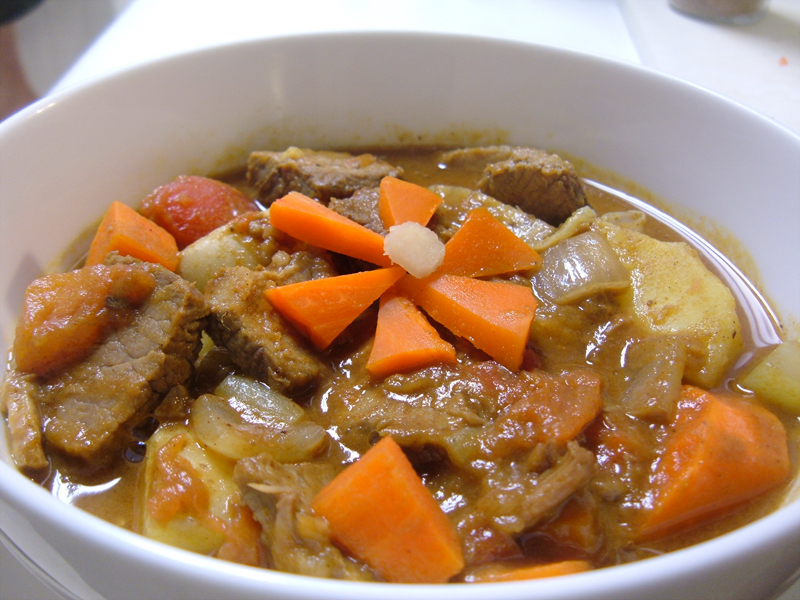
Occasionally I get the urge to cook what no sane, modern man or woman should ever try. Take today for instance—I thought, "Wouldn’t it be great to make Mom’s Japanese curry, but without the help of roux from a box?" Ha bloody ha-ha. Okay, so maybe starting this the day after the cioppino was not my brightest idea. Starting this after finishing a fish stock, a molten cake, a cioppino, and a pesto while also working on two loaves of bread was truly the pinnacle of brilliant scheduling. But like you, I thought, "I just need to make a roux. How hard could it be?" I’ve made roux thousands of times and killed thousands of roux babies. I eat roux for breakfast (okay, not really). But still!
To understand the source of my culinary exhaustion, you must first understand the subject at hand: Japanese curry. You will probably never find a recipe for Japanese curry in a book on authentic Japanese cuisine. Yet if you visit Japan, your Asian grocer, or the local Curry House in Torrance, Japanese curry is practically a fixture; karē raisu (curry with rice) and katsu karē (curry with tonkatsu) are very popular and can easily be made at home with the help of The Box. The Box, full of the aforementioned magical "curry roux," is also full of hydrogenated oils, but it is the go-to ingredient of almost everyone who makes Japanese curry. Without curry roux, there wouldn’t be curry—just a pile of boiled carrots and potatoes. (For an example of a simple curry prepared with pre-made roux, see this video.) My mom raised me on Japanese curry from The Box. I liked curry from The Box… at least, until I discovered what was in The Box. Yurgh.
Karē belongs to a class of Western-style dishes adapted for Japan during the mid-to-late 19th century, following the arrival of the kurofune or the Black Ships. Yoshoko, or "Western food," is not the typical hamburgers and fries you and I know. Rather, think spaghetti noodles mixed with ketchup and stir fried with vegetables, or breaded, deep fried hamburgers. It may sound bizarre to people from the states (minus Hawaii), but before real European and American cuisine was available in Japan, the Japanese were already developing and adapting their own interpretations of our food. Thus karē is almost nothing like the curries of the UK, India and southeast Asia; it is mild not hot, heavily spiced, but slightly sweet. The sauce is usually glossy, moderately thick, and will cling to rice, carrots, potatoes, onions, beef, and pork. NB: You can read more about Yoshoko cuisine here at the New York Times.
Now you know a little about the background of curry. But how do we make curry without The Box? I would like to turn your attention to this thread from Eric Eto over at the Chowhound forums. If that recipe doesn’t make your eyes pop, you’ve never made curry the easy way and you’re not familiar with French sauces. Examine the recipe carefully and you will see that the sauce for curry is actually somewhere near an espagnole or (as Eric points out) a demi glace. Ever tried making a demi glace? No? Well, these days most chefs won’t make them because a jus lié or a reduction is easier to prepare and less costly to make.
I didn’t follow the recipe word-for-word—you’d have to be really crazy to go there, and I’m not certified yet. Did I measure as I cooked? Umm, sure… if measuring is a dab of this here, a little of that there, taste, and ok that needs adjustment. So no measurements. Yet. I’m just going to outline what I did very roughly. I don’t recommend following the recipe for this trial-run yourself, as this dish is still very much in the experimental stage and requires significant revision. My next article on curry will focus more on establishing an exact recipe.
Brown Beef Stock Ingredients
2.67 lbs beef bones
water
red wine
celery
carrots
onion
tomato paste
thyme
parsley stems
bay leaf
clove of garlic
Curry Ingredients
ghee
all purpose flour
salt
pepper
brown beef stock
about 3.5 lbs stewing beef
carrots
celery
onion
thyme
parsley stems
bay leaf
tomato paste
2 apples
fresh ginger
garlic
6 tomatoes
10 potatoes
curry spice mix (whole spices preferred)
garam masala mix (whole spices preferred)
- Prepare a brown beef stock. I won't go into detail here, as brown stock is the subject of a future article. Simmer for 6-8 hours. Skim, strain, cool, and remove fat, then refrigerate for the next day.
- Okay it's the next day. If you don't have any ghee on hand, go make some. Now.
- Chop up the stewing beef into large chunks, salt, pepper, and quickly sear with beef fat or ghee. Transfer to a dutch oven. Add enough liquid to the pot to cover the beef; use all beef stock if you can, otherwise supplement with mostly water and a little red wine. Simmer for two hours, skimming as usual. Prepare and brown a mirepoix with tomato paste as you ordinarily would for brown stock. Add, along with the sachet, one grated apple, and a little grated ginger, during the last hour of cooking. Strain, reserving the chunks of beef, and cool the liquid to room temperature. NB: Technically, straining the liquid isn't absolutely necessary. However, straining at this step will produce an extra smooth sauce and give you the opportunity to further "build up" the sauce in Step 5.
- Using ghee and all purpose flour prepare 12 ounces brown roux. Because you are using ghee, the roux will already start off a lightly colored and quickly progress. In the last minute or so of cooking, add toasted ground curry spices. When finished, add the hot roux to the room temperature liquid from the last step.
- Slice the reserved beef very thinly. The beef isn't tender yet because the two hour simmering period was not long enough to break down the collagen holding the proteins together. You need to do additional cooking for that. Simmer the sliced beef in just enough water (or beef stock) to cover, add skinned, pureed apple and carrot, pureed onion and celery, ginger paste, and salt. It's done when the beef is fully tender.
- In the last 10-20 minutes of simmering the beef, toast garam masala until aromatic, grind, add back to the pan with a little ghee, then add fresh chopped tomatoes (skin removed and de-seeded, of course) and garlic paste. Simmer for a few minutes until the tomatoes are soft. Stir into the beef.
- Combine the beef mixture with the sauce from step four. Continue to cook until all ingredients are heated through. Ladle over rice covered by rustic-style chunks of boiled carrots and potatoes.
Comments on the procedure and suggestions for the future:
- I didn't have enough beef bones to prepare the quantity of stock I needed, so I borrowed some of that flavor from the meat in Step 3. It was awful, and I am never doing that again. I'd rather walk to the supermarket. In the rain. Without shoes. Make brown beef stock with no less than five pounds of bones.
- The curry was delicious and fit the flavor profile I would expect from Japanese curry: rich, intensely saturated with taste of beef, and a little sweet due to the addition of the apple and ginger. I'd like to experiment with a more well rounded contribution of fruit, maybe through the addition of the banana or mango as seen in the other recipe.
- There was a slight, but noticeable taste of flour. This mistake may have been due to a mix-up in the kitchen. Next time just double-check the weights of ghee and flour are equal. NB: Also, the roux changed colors rather fast and should have cooked longer. Suspicious. This roux was my first opportunity to use ghee as opposed to regular clarified butter.
- I didn't use my own mixture of spices for curry and garam masala as this was a trial run, but I believe a customized curry and garam masala recipe would further enhance the dish. Star anise would be a wonderful addition as well.
- This process could possibly be simplified by combining the first beef stock with a roux. I'm not exactly sure what the impact would be on the flavor; the Culinary Institute recommends using a second extraction process for the preparation of all brown sauces and I believe the purpose is to "build up" on the flavors initially developed in the stock. If I was in a hurry, I suppose I might try taking a shortcut.
- If I decide to travel this lengthy route again, use extra roasted beef bones for Step 3 and simply place the meat in the crockpot that morning. By evening the beef will be tender. You can also add a small about of fruit-vegetable puree to the crockpot if you want to saturate the meat with additional flavor, but I recommend waiting until the last hour of cooking to prevent the flavors from going flat.
- The curry was slightly under-thickened on the first night, but the next day I poured off some liquid which seeped to the top. After that, I thought the consistency was just fine.