
North African Inspired Squash Couscous
October 19, 2009 by The swedish meatball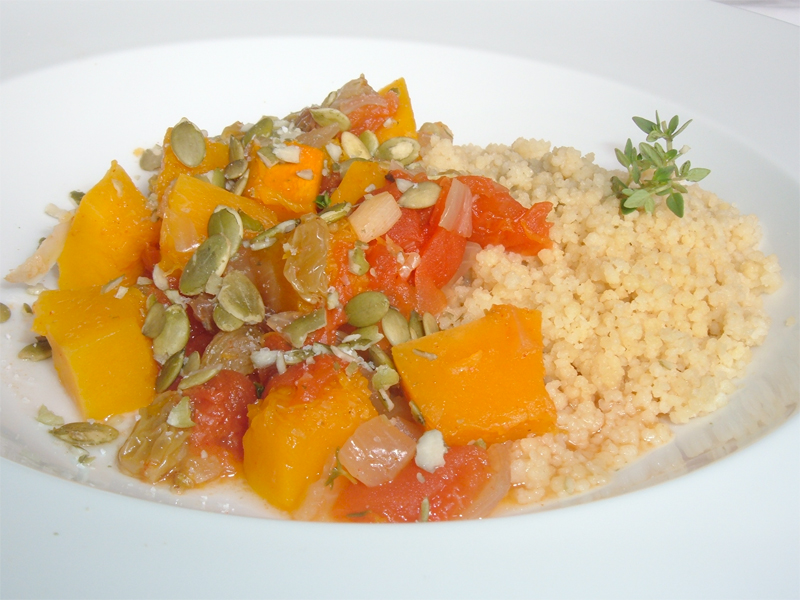
The weather in coastal Southern California can’t seem to decide what season we’re in, but I’m already jazzed about the arrival of Fall. Hot chocolate, morning fog, shorter days, impending food-filled celebrations, time off with the husbot—can I count the ways I love thee? And perhaps more than any other produce, squash is the signature item of the season. There’s quite a selection of squash readily available these days. Butternut squash, pumpkin, acorn squash, and kabocha are only a few of the varieties sold at the local grocery mega-mart and farmer’s market. That said, I don’t cook as often with squash as I would like. The few times I had squash served to me when I was young, the squash was bland or overly sweetened. (Think candied yams.) My husband is even more averse to squash than I am because of his prior experience. But I don’t think the humble squash is to blame for this poor reputation; I think many recipes for squash are just plain boring or poorly thought out. So when I got the yen to use some butternut squash this weekend, I avoided reaching for the traditional (and overused) butternut squash soup and instead tried to recall cuisines that might blend the savory with the sweet in a delicious, but starchy dish. Morocco and Algeria anyone?
Couscous is not exactly my favorite starch, either. I’m particularly disappointed by restaurants which serve couscous on the side, plain and dry, as if its very presence was indicative of haute cuisine. Could you be any less creative? But to be fair, I think couscous has great potential too; the texture is unique—it’s light, airy, and not at all gritty or clumpy if prepared properly—and the taste is just slightly nutty. In essence, couscous is a beautiful canvas that brings its own character to the plate… like painting on rough linen rather than silk. I’ve known that tidbit for a few years, but the Moroccans and Algerians—well they’ve had quite a while to get this dish right. They ply the couscous with meats, roots and vegetables of all kinds, spices, fruits, and wonderful broths. My mouth waters just thinking about it. And as with most ingredients, the key to greatness is in the planning, preparation, and execution.
Ingredients
6 roma tomatoes
Vegetable oil
1 red onion, chopped
Salt
Fresh ginger root
2 cloves garlic
Hungary Sweet Paprika
Hungary Half-Sharp Paprika
Homemade chicken stock
3 saffron threads
Thyme
1 small butternut squash
Golden raisins
Ceylon Cinnamon
"Instant" couscous, not the Israeli variety
Pumpkin seeds
NB: The last few steps apply to "instant" North African (sometimes also called French) couscous, which is practically the only kind of non-Israeli couscous available in the United States. Hand-rolled couscous is supposedly superior, but I have yet to make couscous from scratch.
- Blanch the tomatoes in hot water for 30 seconds, then remove to an ice-water bath for 10 minutes. Peel off the skins, quarter, de-seed, and apply a rough chop. Set aside in a container.
- Halve the butternut squash, scoop out the seeds (an ice cream scooper works great here), cut off the ends, and peel off the outer skin of each half (with a pairing knife or other tool of choice). Then chop the butternut squash into small squares about a half inch on each side. Set aside the squash in a container separate from the tomatoes.
- In a large saucepan over medium-high heat, saute the onions with a little salt. Add a small quantity of grated fresh ginger root, as well as all the garlic (use the garlic press), during the last minute of cooking.
- Season the onions with both kinds of paprika according to taste. I used about equal portions of both.
- Add to the saucepan the tomatoes, a little chicken broth, salt, and the saffron. Cook for about 10 minutes, covered, or until the tomatoes are soft and cooked through.
- Add several whole stalks of thyme to the pot as well as the butternut squash and additional salt. Pour enough chicken stock over the top to barely cover the squash. Cook for 20-30 minutes, covered, or until the squash is just fork tender.
- Remove the thyme from the pot. Stir in the raisins and the cinnamon. Make any last minute seasoning adjustments. Turn off the heat, but cover to keep warm.
- Preheat the oven to 400°F.
- In a cast iron dutch oven, pre-soak the couscous in salted chicken broth for 10 minutes. You should add roughly 1.0x-1.5x (by volume) chicken broth to couscous. If done properly, there will only be a little excess moisture.
- For every cup of couscous, add one tablespoon of vegetable oil to the pot. Then, using your hands, roll the vegetable oil in between the granules, breaking up any clumps. This process should take a few minutes.
- Place the pot in the oven for 10-20 minutes, depending on how much couscous you are making. A smaller batch will require less time.
- Remove the dutch oven to a cool burner. Fluff the couscous with a fork, then immediately transfer the couscous to a cool container or a serving plate.
- Ladle the contents from the saucepan (including the broth) over the couscous. Serve with roughly ground pumpkin seeds on top.
I would love to revisit this dish; the tomatoes perfectly melded the savory chicken stock and spicy paprika with sweet ingredients like the raisins and the butternut squash. Even Tyler could dig the squash here. However, there are a few suggestions for future iterations:
- Use more tomatoes to balance out the quantity of butternut squash.
- Make a generous amount of broth. According to a few cookbooks on African and Middle Eastern cuisine, it's traditional to spoon broth over the couscous, and I can see why. Dry couscous is not nearly as tasty as couscous moistened by the pot liquid—which is, in my opinion, where the flavors really get together and party. Of course, if you add too much broth, you might lose the texture of the couscous. Just use your best judgment when serving.
- Try creating couscous from scratch! Okay, this might be too ambitious if you just want to put dinner on the table, but it would be a great experiment.