
Spatchcocked Sichuan-Spiced Chicken served with Wilted Chinese Spinach and Kale
October 19, 2009 by The swedish meatball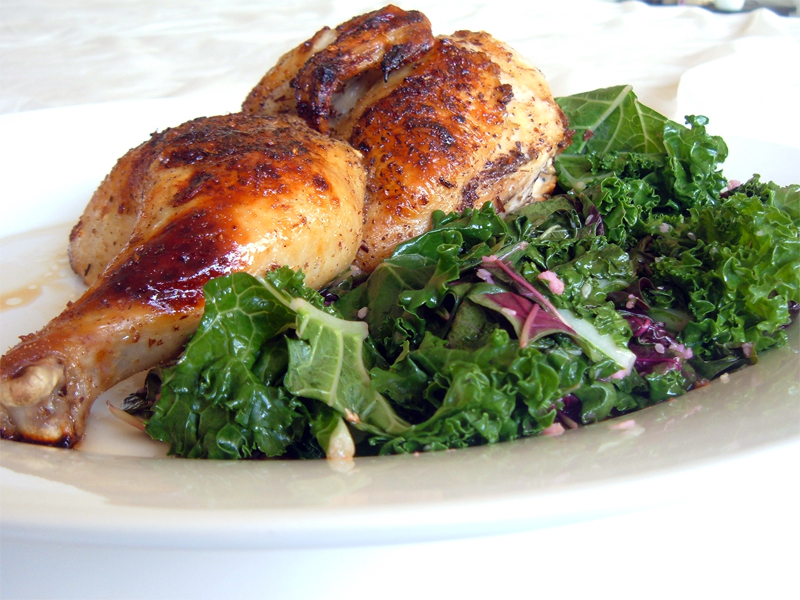
Okay, I had planned on roasting the chicken with a persimmon glaze. However, there were two major problems with this approach. Problem One: persimmons are delicately flavored and, short of a mild cream or custard sauce, are difficult to pair with other flavors. Even too much sugar or honey seems to destroy the subtlety of the persimmon. Problem Two: fuyu persimmons, the kind I usually buy, don’t really have the texture to make a proper glaze. Imagine trying to make a glaze out of something like partially cooked carrots. (Usually you glaze the carrots themselves, not make a glaze out of them.) Nothing I did, including softening the persimmons via cooking and straining in a sieve, yielded the smoothness you associate with a glaze. Arrowroot might have given me a more shiny or glossy sauce, but without the texture, the whole deal was a bust anyway. So there’s a lesson learned: never, ever try to make a savory sauce out of fuyu persimmons. Hachiya persimmons might do better, but you’d have to use the softest, ripest fruits to avoid the astringency associated with that variety. It’s such a shame; I love persimmons. I was really hoping to bring their deliciousness to a main course.
That said, dinner was far from a bust. The spice rub was good, the chicken was beautifully tender and juicy, and the wilted greens were fabulous—that last bit is the real surprise because I usually find myself saying "meh" to most green side-dishes. Also, spatchcocking a chicken is just plain darn fun.
Ingredients for the Spatchcocked Chicken
1 whole young chicken
Sichuan peppercorns
Star anise
Ceylon cinnamon
Fresh ginger root
Salt
Garlic powder
Lemon juice
Honey
- Take the chicken out of the bag. Remove the neck and the giblets from the carcass, then wash the chicken and pat dry. Bring out your kitchen shears. Cut out the chicken spine and remove the breast bone. (See this great video for a visual demonstration of the technique.) You'll hear some crunching as you cut through certain bones, and the breast bone may give you some trouble, but don't let that stop you. Just be patient. Trim excess fatty tissue, but leave the skin in tact. When you're done, you can cut the chicken in half or leave the carcass flat but whole. Personally, I like halving the chicken; one half-chicken is a great serving size for two, and you can save the other half for tomorrow.
- Toast the sichuan peppercorns, the star anise, and the cinnamon on a hot pan, then grind the spices. Grate some fresh ginger over the chicken, and season the chicken with the ground spice mix, the salt, and the garlic powder. Pat the rub into the chicken, ensuring everything is evenly coated.
- Place the chicken in a large Ziploc bag and add enough lemon juice to moisten the chicken. Let the contents of the bag marinate for several hours or overnight in the refrigerator. When you're ready to cook the chicken, first take the chicken out of the fridge and let the chicken warm up a little.
- Preheat the oven to 400°F. Preheat a large pan with an even coating of peanut oil. The burner should be set to high or medium high. When the pan is very hot, sear the chicken skin-side down. Turn the chicken over and place the whole pan in the oven. Turn the oven temperature down to 350°F. Optional: occasionally baste the chicken with a mixture of honey and hot water.
- Remove the chicken from the oven when the breast meat temperature reads 160°F. Let the chicken rest for 5-10 minutes. Serve with wilted greens.
Ingredients for Wilted Greens
Sesame oil
Sesame seeds
2 cloves garlic
Fresh ginger root
Brown rice vinegar
Splenda
Chinese spinach (leaves only)
Kale, roughly chopped
Salt
Black Pepper
- Heat a little sesame oil and all the sesame seeds in a pan over medium or medium-low heat. Allow the ingredients to warm for a minute or two, then add the garlic via a garlic press. When the garlic becomes aromatic, add the brown rice vinegar. Add Splenda or sugar to taste. Then add the Chinese spinach, the Kale, the salt, and the pepper. NB: Be careful when adding the vinegar. The vinegar should balance the sesame without overwhelming the flavor entirely. You can taste the mixture once you've added the Splenda; just don't breathe in while tasting!
- When the spinach is fully wilted and the kale is partially cooked, remove the greens to the serving plate.
This dish is more simple than I had planned, but I’m mostly pleased with the results. The Chinese spinach was not quite as fibrous as regular spinach, so I’ll definitely be revisiting that ingredient in the future. (I found it incredibly cute that the spinach turned other ingredients, like the garlic and the sesame seeds, pink.) I may add the Kale a little before the spinach, as the spinach cooks faster. The chicken, as mentioned earlier, was perfectly cooked; however it lacked that something extra. It needs a dipping sauce at the very least, but I’m not exactly sure what that would be. Something to ponder for next time…