
Graham Cracker Dough and Pie
October 26, 2009 by The swedish meatball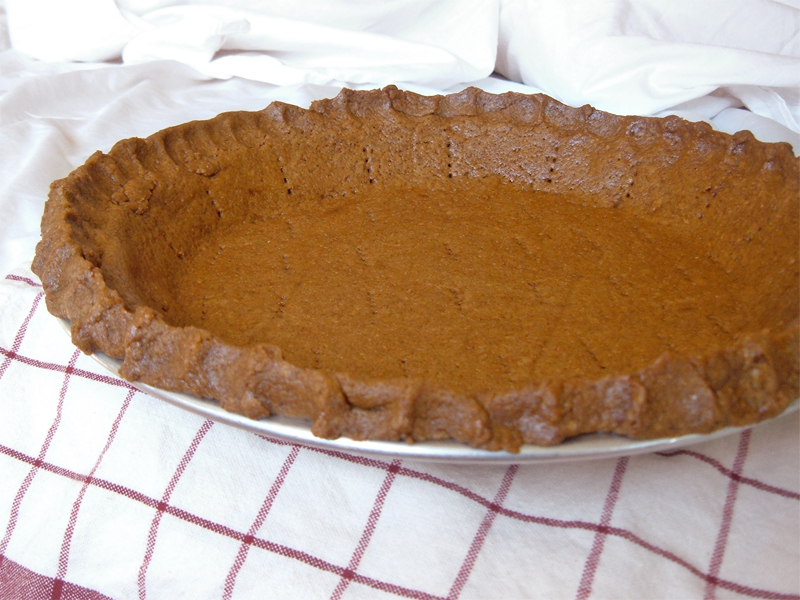
In an ideal world, I’d test all of Reinhart’s recipes before the end of the year. This goal is looking less and less likely, but I’m not really disappointed. With patience and repetition, I’ve gained insight into the "feel" of various doughs—very important because each type of bread has different qualities prior to baking. The better you get at identifying and aiming for these characteristics, the better your final product. Within the next several months or so, I anticipate quantitatively adjusting Reinhart’s formulas to my own specifications; I’ll post the results when I’m comfortable with their accuracy. NB: Remember most of these adjustments are specific to the environmental conditions of my location: temperature, humidity, etc.
Meanwhile, I am making progress through the book. After pizza crusts, I decided to turn my attention to the sweeter bread varieties in preparation for the holidays. By Christmas, I will probably have added Hutzelbrot, Stollen, Brioche, and/or Boston Brown Bread. This past week, however, I took a crack at Reinhart’s Graham Cracker formula. I ran two trials and a third is scheduled next week. Here are the results thus far:
- In the first trial, I reached for my usual staple—hard white whole wheat flour. The dough was both slightly crumbly and sticky (which, according to Reinhart, was bad). However, with the application of a little nonstick spray, a regular ball bearing rolling pin had no problem rolling out a flat, even sheet. The dough puffed up significantly during baking.
- Graham flour was substituted in during the second trial. Initially, the dough was very soft and crumbly. I mixed in additional flour and a little extra milk, gave the dough a short period of rest, and tested again; the dough was strong and responded well to molding—just about perfect. NB: adding both flour (dry) and milk (moist) to a dough is a bit unusual, as one usually counteracts the effects of the other. However, in this case, the problem appeared to be the excessively high sugar content of the dough.
- The whole wheat graham flour exhibited less rise during baking, and provided a superior texture—with more variation in the size of grain that the regular flour. It's difficult to describe accurately, but the coarse granules provided an extra earthiness or grit in your mouth, while the the smaller granules held the cracker together.
- The crackers were more intensely flavorful (less bland) than the graham crackers you buy at the store; they were also very crispy around the edges and just a tiny bit chewy on the inside. The crackers share a few characteristics with waffle cone wafers, but actually have too much toothiness (resistance to biting) to actually be a wafer.
- For the sake of curiosity, I rolled some of the dough from each batch into a pie crust. The first crust I blind-baked for 20 minutes in an attempt to prevent the bottom from turning soggy; however, the bottom of the crust and the fluted edges burned when the pie was returned to the oven with the pumpkin filling. The second crust I baked raw with the pie filling; I also covered the pie with an aluminum foil pie shield and moved the pie off the baking stone to a regular rack. The fluted edges still burned a bit on one side. However, the rest of the crust turned out alright; it's not my favorite, as I would have preferred a crust more resistant to absorbing moisture. Tyler, contrary man that he is, likes it. I have to admit, the flavor is superior even if the texture leaves something to be desired. NB: As much as I prefer the graham flour, I wonder if the second batch's crust was more prone to absorbing moisture because of the additional coarseness. Hard to say. Personally, if I were to serve this as a dessert, I would make little ramekins of pumpkin custard and serve them with thin, shaped graham "wafers," whipped cream, and a dusting of cinnamon.
FRAKKIN TOASTERS STEALING MY FRAKKIN PIES
Listen to the music Saul.
THE MUSIC IS COMING FROM INSIDE THE FRAKKING PIE