
Pizza: Take One. Crust, Piquillo Peppers, and More.
October 26, 2009 by The swedish meatball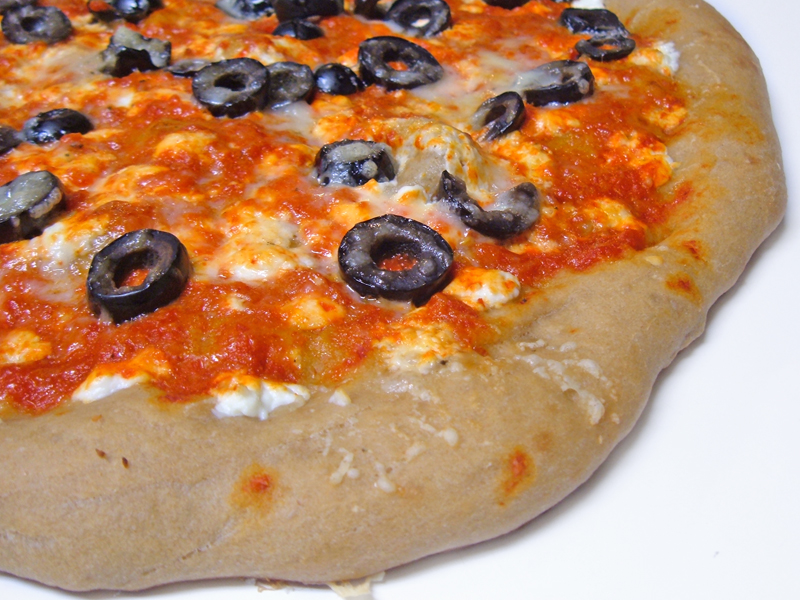
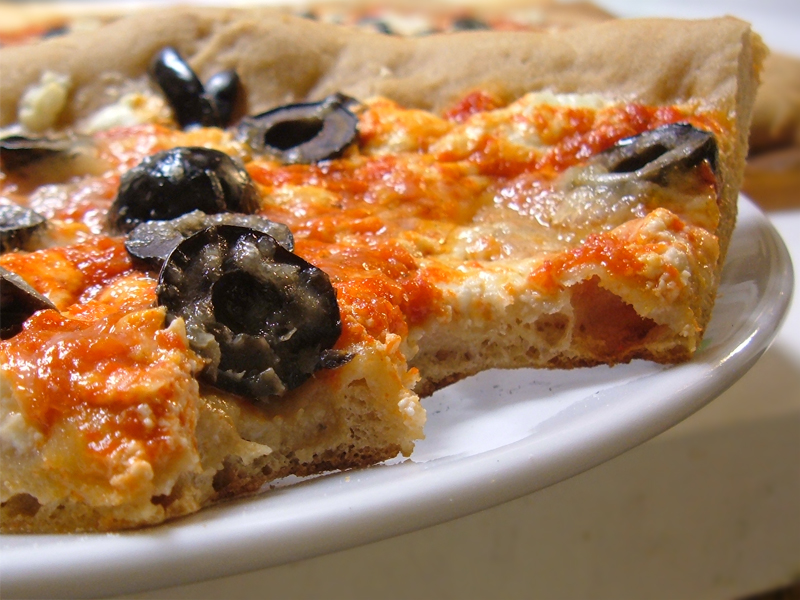
Having obtained a fabulous baking stone from Fibrament in August, I’ve subjected the stone to a rigorous baking schedule—boules, batards, and sandwich loaves at least twice a week. I was quite pleased with the performance, but as of last weekend the final test had yet to be performed: pizza. Years prior, I’d experimented with several hand-made whole wheat pizza crusts on cheap sheet metal; the results were o.k., but nothing worth preserving in the annals of Jenn kitchen-history. However, this time ‘round I was armed not only with the proper equipment, but also a baker’s formula from Peter Reinhart. The stage set, Fall arrived just in time to crank my oven up to 525°F.
But what toppings would I add? By chance, I saw a piquillo pepper Spanish tapas on food gawker. The visual triggered a memory of Bobby Flay’s delicious grilled portobellos stuffed with wild rice pilaf and piquillo vinaigrette. The possibility of revisiting the piquillo pepper as an ingredient was too tantalizing to resist.
I was less happy to discover Whole Foods stopped stocking piquillo peppers. Tyler and I made a long sojourn out to the illustrious restaurant supplier Surfas of Culver City, where we paid $10 for one measly can. So barring a special occasion, this pizza is probably the last we’ll see of piquillo peppers for a while.
Ingredients for the Topping:
Piquillo peppers
Sweet paprika
Half-sharp paprika
Garlic powder
Salt
Black olives
Fresh goat cheese (from farmer’s market)
Manchego cheese, coarsely shredded
Instructions: Turn your oven to its highest setting. Warm the baking stone at this temperature for one hour before proceeding to bake. Prepare the dough and lay out on parchment paper. Combine the first five topping ingredients and puree in the food processor. Spread a very light coating of the puree over the dough. Crumble goat cheese, spread out the olives, and top the pizza with shredded manchego. Slide the pizza onto your baking stone by pulling on the parchment paper. Bake the pizza for 5-10 minutes. Optional: You can remove the parchment paper after two minutes if you’re concerned about burning the parchment. Or, you can spray the parchment paper with oil (preferably high smoke point).
Remarks and suggestions concerning the results:
- The baking method is infallible. The crust is superior to any I've made previously, and the bottom of the pizza is perfectly seared and browned. If you're wondering why the baking stone is heated for an hour, numerous sources suggest that a longer preheating period for the baking stone will yield a better crust. I happen to agree. Skeptics may turn to the test-result write-ups in Cook's Illustrated.
- The pizza dough is incredibly easy to assemble. As usual, the Reinhart recipe is excessively wet, so adding extra flour is necessary.
- The pizza was removed from the oven five minutes into baking. That may have been a little premature; the crust puffed and was nicely chewy, but I would like to see more crispness overall. The next batch on Friday will be held in the oven for an extra 1-2 minutes. Lowering the oven shelf to the bottom may be necessary, but I will wait for the second test results before drawing any conclusions.
- The texture of the dough is not quite right. In my opinion, the best pizza crusts have a little dry coarseness—usually supplied by the application of cornmeal (and possibly more oil) if I'm not mistaken. Further testing is required. Fortunately, Reinhart has a multigrain formula for future play.
- Avoid using a rolling pin to form the crust. Flatten the dough into a disk on the counter, then lift the dough, place your knuckles underneath and gently stretch the dough out. If the dough begins to tear instead of stretching, finish the stretching on the counter using your fingers to press the dough outward and around. This procedure (unlike the rolling pin) will yield a natural outer crust without folding or crimping dough at the edges.
- If the dough begins to "snap back" and contract during shaping, let the dough rest for several minutes before continuing.
- Whatever you do, do not pile on the toppings. After a bad dough, the number one cause of soggy pizza crusts is an overloaded pizza. Go very light on the sauce. Add at most three kinds of cheese and three toppings.
- Tyler and I both loved the tang of the goat cheese, which meshed very well with the piquillo peppers. I would like some kind of sweetness in the toppings to break up the intensity of the cheeses and peppers—fresh tomato? Or, alternatively, I could use whole slices of pequillo pepper, the same cheeses, but with a sweet tomato sauce. The variations never end with pizza. Friday's batch will probably be more traditional with mozzarella, romano cheese, fresh tomato slices, basil leaves, a tomato-anchovy sauce, and possibly some kind of balsamic reduction as a garnish.
Watch this article for updates. If there’s anything to add about Friday’s batch, it’ll be posted here.
Update 11/03/09 Morning
- Bake the pizza for 6 minutes. Browning just begins to occur at this point, which is ideal.
- For the plain mozzarella-romano pizza mentioned earlier, here's a helpful guideline for adding just the right amount of sauce: you should still be able to see the bottom dough, but visibility should be reduced by 60-70%.
- After adjustment, the Reinhart formula exhibits excellent stretching qualities. I was able to obtain an extremely thin crust, typical of a New York style pizza, without reducing the crust to a cracker-like texture. (The slices were pliable without being soggy.) People who prefer thicker crusts should have no problem rolling a pizza with a smaller diameter. One batch of dough will make two large, New York style pizzas or two medium thicker crust pizzas (think Dominos hand-tossed).
- The addition of grains—oat bran, pre-cooked steel cut oats, and flaxseed—added a great texture to the dough without sacrificing flexibility. Of course, you'll need to add even more flour to account for the extra moisture in the oats. NB: I wasn't quite satisfied with the feel of the outer crust, which is still clearly missing the contribution of the cornmeal. Stupid allergies. I may be able to simulate the missing coarseness with larger grains dusted on the outside: rye or even graham flour. More experimentation is necessary to be certain.
Update 11/03/09 Evening
I dusted the outer edges of the pizza dough with whole wheat graham flour before baking. The results were beautiful—just what I was looking for in terms of coarse grit, minus the corn. Granted, cornmeal also adds an extra sweetness, which is also a nice touch, but not necessary.
We tested a topping mix of whole piquillo pepper slices, thinly sliced tomato, mozzarella, romano, basil, and tomato-anchovy sauce. The sweetness of the fresh tomato and the tomato sauce was great, but the peppers really needed the manchego or goat cheese; unfortunately, we had no open packages of either cheese available.
Final weight of the dough: 1076g. Character: a touch too wet, but not enough to negatively affect the stretching qualities of the dough.