
Brown Beef Stock
November 6, 2009 by The swedish meatball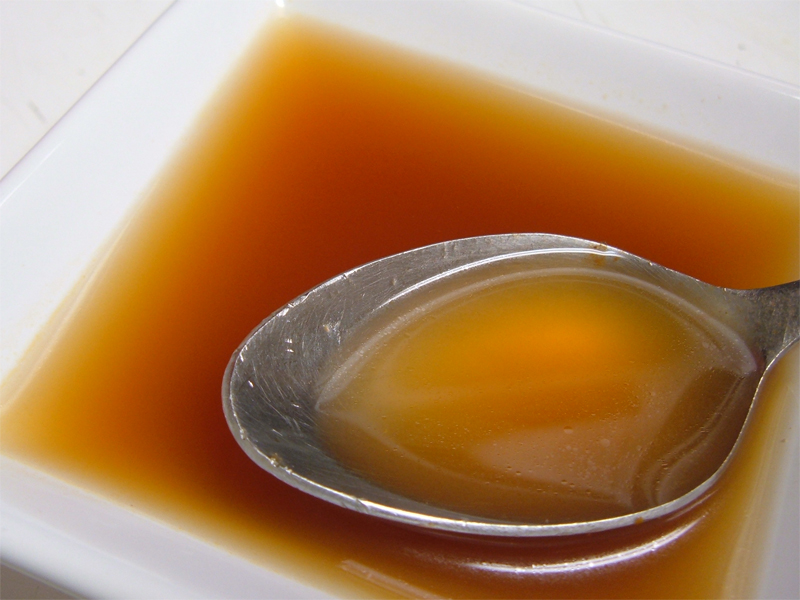
In a previous article, I delivered a fairly thorough overview of stocks and outlined a recipe for fish stock. I dislike repeating myself, but for the sake of clarity, let’s start with what we know (or should know). There are three basic types of stock: white, brown, and fumet. Fish stock belongs to the first category, and is thus fairly simple to make; there’s some chopping and a fairly short simmer time, but no extra work is involved. Brown stock, the subject of today’s article, requires a little more preparation and a lot more time. I won’t pretend to be an expert in this arena. I’m still working out the kinks in this recipe, and there are a few practical matters to address in the future. But if you’re looking for an inroads into the topic, read on.
Brown stocks are characterized by a "rich mahogany color". Four important processes determine the vivacity of color in your brown stock and thus define this class as a whole:
- Roasting the bones in the oven prior to simmering.
- Deglazing the roasting pan.
- Browning the mirepoix on the stovetop prior to entering the stockpot.
- Caramelization of the tomato paste. The paste should turn rust brown-red and emit a sweet odor.
Brown stock can be made with a variety of bones. Fresh or smoked pork bones, lamb bones, chicken bones, and wild game bones are only several of the choices available for use. Quite often, veal bones are preferred over regular beef bones because the younger animal contains a higher proportion of connective tissues (cartilage), which in turn lends greater flavor to the stock. Neck bones, knuckle bones, and back bones are also great for stock recipes. But whatever your selection, pick meaty bones over lean ones. Marrow bones are occasionally used for white beef stock, but brown less easily making them undesirable for brown stock.
Ingredients
6.66 lbs beef soup bones and beef neck bones
vegetable oil
18.25 cups cool water
1 tsp salt + extra
190g white onion, ½ inch dice (slightly more than half a large onion)
95g celery, ½ inch dice
95g carrots, ½ inch dice
118g tomato paste
1 large sachet consisting of a bay leaf, a sprig of thyme, parsley stalks, a clove of garlic, and peppercorns
- Buff the interior of the roasting pan with a thin layer of oil. Preheat the oven and the roasting pan to 450°F.
- Add the bones to the roasting pan and return to the oven. Turn the bones every 15 minutes and cook for 35-45 minutes or until the bones are deep brown.
- While the bones are in the oven, transfer all but one cup of water to a large, nonreactive stockpot. Add 1 tsp of salt.
- When the bones are finished roasting, transfer them to the stockpot. Deglaze the pan with the remaining cup of water and use a nylon or silicone spatula to scrape up the brown bits on the bottom. Transfer the deglazing liquid to the stockpot.
- Bring the contents of the stockpot to a simmer. Skim the surface (at least) every hour for the next 4 hours and 45 minutes; remove all fat, foam, and debris which collect there. Then in a wide pan over medium high heat, brown the mirepoix with a little vegetable oil and salt. Do not crowd the mirepoix in a small pan or you will sweat the mixture instead of browning.
- When the mirepoix is thoroughly browned, add the tomato paste to the pan. Stir frequently to (re)distribute the paste and prevent the paste from burning. Cook until the paste caramelizes or about 1-2 minutes. Look for the characteristic rust brown color and a sweet odor. Remove the pan from heat immediately.
- By now the stock should have simmered for at least 5 hours. Add the mirepoix mixture to the stock and simmer for an additional 30 minutes.
- Add the sachet and continue simmering for 30 minutes.
- Strain and cool the stock.
Brown stock is somewhat new to me, but I’ve carried out this procedure twice in the last month. The first round was for Japanese curry; the second was just for kicks—and also because I’m leaning toward braised ribs, beef barley soup, bourguignonne, or even a chasseur sauce in future days. (Ah, the possibilities!) The first batch was quite wonderful. The second is alright, but needs improvement. There were a few minute differences between them, which I will outline now as a useful entry into my critique:
- The first had slightly less tomato paste than the second (by ratio).
- The first was made in the cast iron enamel pan, the second in a stockpot.
- The first used a large, wide roasting pan for the bones, but as there were more bones in the second batch, the pan was insufficiently wide to accommodate all of them without stacking.
- The first was simmered slightly longer prior to adding the mirepoix, and also lost quite a bit of liquid. When I refrigerated the stock, the stock turned completely gelatinous—indicating to me that the contents were more akin to a glace (highly reduced stock) than an actual stock. To see a visual example of gelatinous stock, scroll down Shari's page on brown stock and you'll see what I mean.
These variations aside, the stocks followed the same procedure and used the same ingredients. However, the first stock was not only rubbery and gelatinous (desirous), but also a deep rich brown full of flavor. The second stock was not gelatinous at all, less brown, and slightly more red than palatable; the flavor was also slightly inferior to the first batch. In light of these observations, I would recommend the following:
- Use veal bones, if you can. I'm a little hesitant to search for veal bones simply because beef bones are cheaper and more accessible, and I would like to create beef stock frequently (rather than when I can afford the expense). However, a veal stock will likely need less reduction and result in more stock.
- Reduction appears to be a key process in producing great brown stock. I've read through a few respectable blog articles on stock, including one from The French Laundry at Home and another from Ruhlman. Combining this information with what I observed in my own stocks, reduced stocks produce a superior product, if somewhat less volume than I would like. Also, combining the stock with a remouillage (from French, "rewetting") prior to reduction appears to be a common, useful trend.
- Use less tomato paste. For variation, consider adding fresh tomatoes or mushrooms to the stockpot with the mirepoix.
I may continue to edit this article for a few days, but as I have more cooking and writing to concern myself with, I’ll just release this as-is.