
Thanksgiving Preparations: Part I. Roux, Hearth Bread, and Other Goodies
November 14, 2009 by The swedish meatball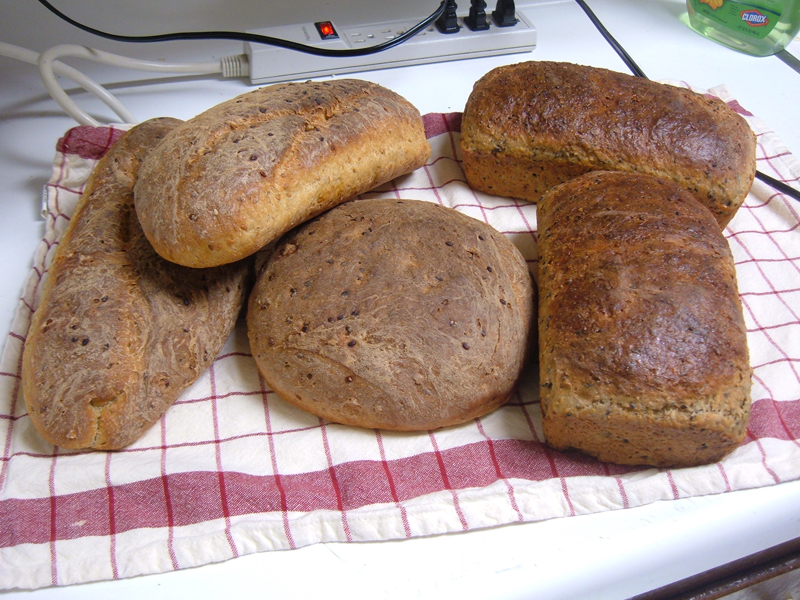
Sweat was flowing down my back, and I was still catching my breath after running on the treadmill. My husband, returning to the gym room with the weekly grocery ads, turned to me and grumbled, "There’s no special on turkeys this year." "Huh?" was my articulate response. I looked and indeed, there was barely a nary a mention of the holiday bird. I shrugged and said, "So?" He eyed me somewhat blandly and said, "Thanksgiving is next week." I gaped at him. I stuttered. I vehemently denied. And then I realized I was speaking with the family’s resident encyclopedia of doom, and I thought, ‘He must be right.’
The next two days were a flurry of activity. I researched, edited, and finalized most of the Thanksgiving menu and all associated recipes. I developed a day-by-day schedule to accomplish the twenty-something mini-tasks of preparation for Thanksgiving. I mixed bigas, soakers, pre-soakers and starters. I finished a double batch of multigrain hearth, a double batch of power bread, a double batch of graham crackers, a single batch of whole wheat crackers, and a single batch of transitional pain de campagne ("country bread"). I clarified 565 grams (2 ½ cups) butter. I made a blond roux. I was just about to start a dark brown roux when my husband had his moment of Eureka: "Honey, I was wrong. Thanksgiving isn’t next week."
Kill.
Okay, so I didn’t strangle him. Or shed any blood. And certainly, a little extra rush on the Thanksgiving preparations doesn’t really compare with being elbowed in the face on Valentines Day or swallowing massage oil the night before my wedding (shudder). But still. My plans!
There’s a lesson to be learned here, ladies: never trust a man to tell you when to schedule a meal.
Oh yeah, and: never accept someone else’s version of "truth" or "fact" until you’re proven wrong.
But no harm, no foul. The bread is in the freezer and, short of a power outage (glares suspiciously at Edison), will last until Thanksgiving easily; and of course, the roux and clarified butter will keep practically forever. In fact, I might even (begrudgingly) thank Tyler for stopping the procrastination. I’ve developed a much easier schedule for this week, and with all the prep work, I’m sure to have time on actual Thanksgiving day for non kitchen-related fun.
Bread Baking Extravaganza: Multigrain Hearth, Powerbread, Transitional Pain de Campagne, and an Honorable Mention
I haven’t written about the experience until now, but the last two weeks have overseen my first foray into true hearth breads. Previous boules and batards were of the enriched variety, sweetened and softened with honey, oil or butter, molasses, and other ingredients; breads of this category produce soft, tender interiors primarily suitable for sandwich bread. Today’s multigrain and country bread baguettes were very lean. The transitional (partial whole grain) country bread, contained no extra ingredients beyond flour, yeast, salt, and flour. The multigrain contained half the recommended amount of oil—14g for a double batch—and no sweetener whatsoever.
After adding extra flour, the double batch of the multigrain bread produced a final dough weighing in at 1891 grams. That’s about 4 ounces heavier than expected. However, the addition of wet cooked grains appears to produce exceptionally wet doughs, as seen in the multigrain struan. You’ll have messy hands for the first 10 minutes or so until you incorporate just the right amount of extra flour to counteract the liquid. After that, it’s simple. For the second rise, I split the dough into three roughly equal portions of 630 grams, formed two batards on my perforated french loaf pan, and shaped a free-standing boule. (See the picture at the top of this article.) I haven’t cut open the loaves to see the crumb, as they’re being saved for stuffing, but so far I’m quite satisfied with their appearance and rising behavior. Expect more comments on this bread when I post the stuffing recipe.
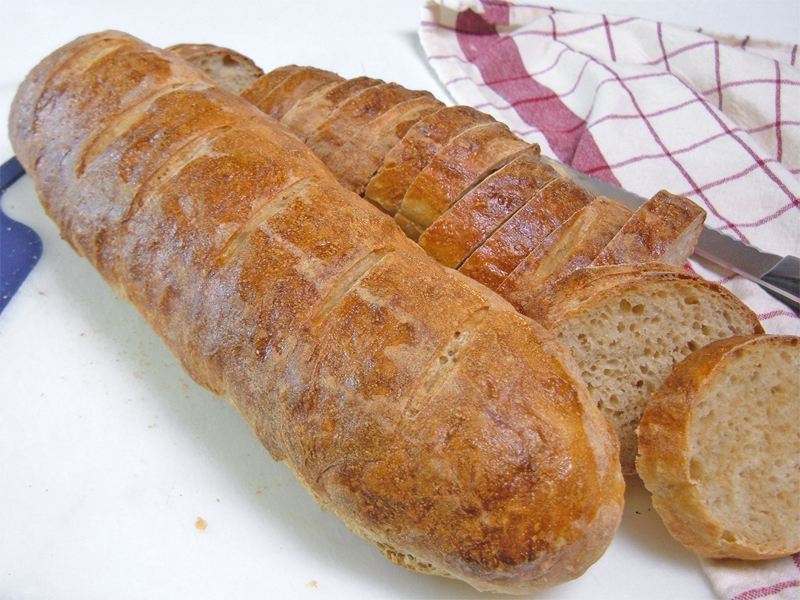
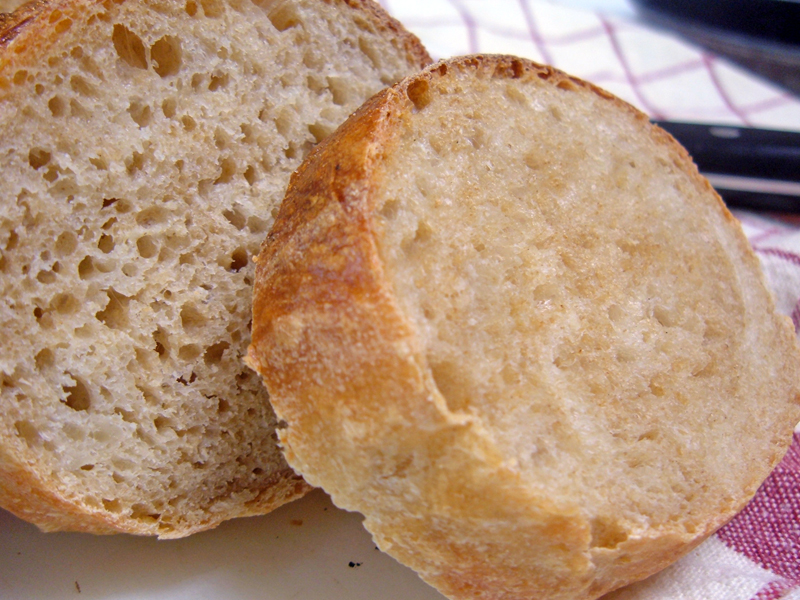
The transitional country bread, otherwise known as pain de campagne, had a final dough which weighed in at 801g total. That’s about on-target with calculations and reflects the fact that no additional flour was needed! There was some additional prep work involved at the fore, as I substituted out part of the flour (50 grams) and water (50 grams) in the biga for a custom-made unbleached bread-flour sourdough starter (100 grams). That aside, the country bread was ridiculously simple. Little kneading was necessary. After the first rise, I divided the dough into two 400 gram portions and shaped two large baguettes for my new $20 Chicago Metallic perforated baguette pan. Fifty minutes later, the oven was prepped. I gently scored the surface, brushed on an egg wash for that little-extra gloss and baked them for 20-25 minutes. You can see the results in the pictures below. The crumb was medium width; the interior texture was lighter and the crust was thin and crispy—facts which I attribute to the use of unbleached bread flour instead of whole wheat flour. The flavor was mild, perhaps even somewhat dull, but there was a lingering taste of sour in the mouth. To achieve a more upfront sour characteristic, I would suggest replacing most or all of the biga with a sourdough starter (preferably after several days in the fridge).
The power bread was, as always, exceptional. (That’s also in the very first picture at the top.) The final dough weight of the double batch was 1818 grams, which formed two 909 gram loaves in my cast iron bread pans. The salted egg wash produced a beautiful glossy surface, and the rise was just what you would expect for a bread heavy with fruit, nuts, and seeds. I can’t wait to test this bread in a savory Thanksgiving stuffing!
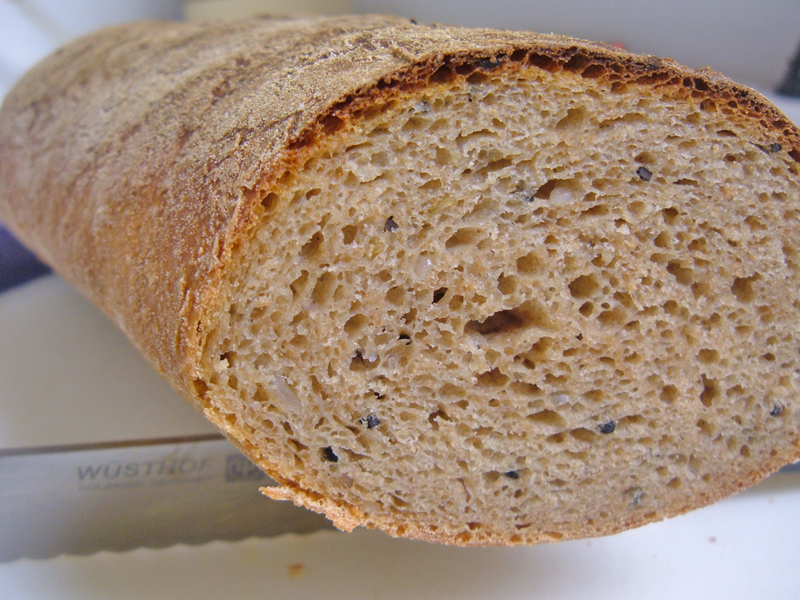
As an addendum to this write-up, I’d like to mention another bread which didn’t make it into its own article: 45% hearth rye bread. The loaf (pictured below) was actually baked somewhere in the vicinity of Nov 7th. It’s not part of the Thanksgiving prep—just a little something I baked for myself as a healthy, controllable source of carbohydrates and a good snack. Rye breads are notoriously persnickety in terms of crumb, fermentation character and the like. My very first attempt at a rye batard, using no shaping pan and a heavily enriched formula, was terrible: flat, ugly, burnt. Simply awful. This beautiful rustic batard was done lean in the perforated french loaf pan. I added onion flakes, anise seeds, and charnushka, and used a steam pan to produce a chewy, thicker crust. The crumb, as you can see, is open. Yet the interior is still soft. For future improvement, I would suggest moving the charnushka to the exterior surface of the bread to provide a better flavor contrast to the anise. Otherwise, I found this loaf to be extremely satisfying. Did I mention rye bread is one of my favorites?
Going Crackers: Whole Wheat Honey Glazed and Revisiting Graham Crackers
I’ll admit: I’m a complete novice at crackers. The subject is just not something I’ve ever put much thought into until very recently. That’s not to say I don’t like crackers. I do—probably too much, given that most crackers are not made of 100% whole wheat. For a while, I had a love affair with Ak-Mak’s delicious Armenian whole wheat crackers and abstained from eating bread. Obviously, the bread ban is off and I’ve become a more sensible eater. I still enjoy crackers, but like any person conscious of excessive carb-intake, I’m also wary of them.
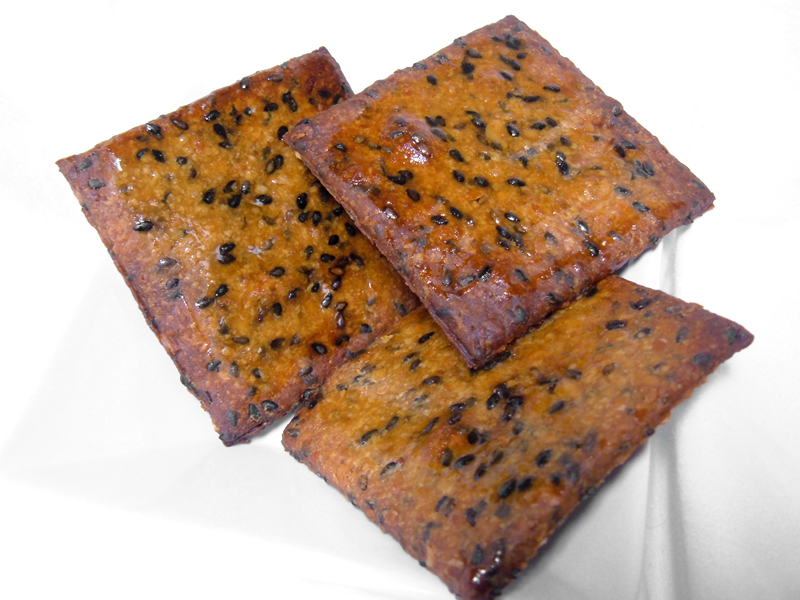
For Thanksgiving, I prepared just a single batch of these 100% whole wheat sunflower-sesame crackers with a honey glaze. (See the picture below.) I plan on serving them with cheese and fruit; I was originally thinking St. Andre’s Triple Creme Cheese and pears, but after tasting the cracker, I may need a revision of plans. The honey glaze is excellent, but the black sesame seeds are excessively strong. Future renditions of this cracker should probably use a combination of black and white sesame seeds.
Above all, I have one gigantic complaint about both this cracker and my double batch of graham crackers: thickness and texture. I used a ball-bearing rolling pin to thin out the dough as much as possible, but the crackers were still too thick. The strong toothiness (bite-resistance) of the whole wheat cracker must be balanced by rolling the dough very thin, lest the toothiness become unpleasant. The graham crackers also requires a very thin dough, or the interior becomes chewy rather than crispy. Also, the dough must be completely uniform; even a slight variation in thickness can lead to burning some crackers while others remain half-baked. Expert human pastry chefs would be hard pressed to produce something so perfect.
What’s the solution to this dilemma? Machines, of course. At least, that’s what I think. I’ve read about others doing this, and I’d like to try it: using pasta machines to roll cracker dough. It makes sense. So until I obtain a pasta machine, I’ll probably avoid further experimentation with baking crackers.
Roux
I’ve avoided writing anything about roux, clarified butter, and ghee for a while now. All three of these subjects are interrelated, but my biggest stumbling block was (surprisingly) roux. I started an article about roux and poked around for various references on the subject. The experience was somewhat disorienting. The public resources available frequently conflict on the ratio of fat to flour. All Recipes calls for equal parts flour and fat by weight; if you’re using butter, that means (according to them) using 2 Tbsps of flour to 1 Tbsp of butter. In summary, that’s a 1:1 ratio by weight and a 2:1 ratio by volume. Note that no mention is made of clarifying the butter. Rather, the formula is "quick and dirty," intended to be made in small quantities on-demand for tonight’s dinner. Chuck Taggart, author of the respectable Gumbo Pages, initially suggests a 1:1 ratio by volume, but admits he prefers a 5:4 ratio. OChef offhandedly subscribes to a 1:1 ratio by volume. If you consult the chefs of Food Network, the advice is no less muddled. Alton Brown suggests a 3:2 ratio by volume. Emeril Lagasse, on the other hand, sticks with a 1:1 ratio by volume. The Professional Chef from the Culinary Institute defines roux in a 3:2 ratio—but by weight, not volume.
Whom do we believe?
Until recently, I didn’t have an answer for this question. In the distant past, when I only prepared very small quantities of "white" roux, a 1:1 ratio by volume suited me just fine. Melt a ¼ cup of butter until hot, whisk in a ¼ cup of all purpose flour, cook until no longer raw, and finis! The method was quite easy and the roux thickened my liquids just fine, even if the color wasn’t exactly right. In the last few months, however, I’ve had the opportunity to experiment and ponder the issue.
First: in what way should we define a preferred ratio, by weight or volume? This question may seem irrelevant to the uninitiated. But as any pastry chef worth his (or her) salt knows, using volume to measure flour is inconsistent and unreliable; depending on supplier and the aeration of the flour in your particular bag, a cup of flour will not always weigh exactly the same. (Bad! The weight should always be the same if the same amount of matter is present.) This issue won’t trouble you in small quantities, but for large formulas, using volume as a measure is tantamount to anarchy. That’s why true baker’s formulas always list flour in terms of percentages by weight rather than volume.
Second: what flour should we use? Most recipes will list all purpose flour. Cake flour and pastry flour are reputed to have better thickening power because they have a higher proportion of starch to protein. I’ve successfully used pastry flour in the far past, but have yet to record any comparative observations. I would say use what is available, but avoid bread flours, which have a high protein content.
Third: what type of fat should we use? Clarified butter is usually preferred for its superior flavor and multipurpose application. However, roux made with rendered fat is also a popular choice when thickening sauces to accompany various meats—for example, rendered chicken fat roux in chicken veloute. Oils may also be used in roux, though they are not renown for their flavor. In fact, vegetable oil or peanut oil are frequently the choice of those in a hurry to prepare a peanut or dark chocolate roux, as using butter will require more time, patience, and whisking.
Fourth: what ratio (by weight) should we use exactly?
This question brings me to the subject of my last two experiments. Though I shrugged off the residual "flour" taste in my Japanese curry article as a mishap in the kitchen, in fact the curry roux was an experiment designed to test the Culinary Institute’s ratio of 3:2 by weight. (I didn’t mention this wee fact at the time because of all the explanation that would entail.) The flour was certainly cooked long enough to not taste "raw," so I can only conclude that the amount of flour used was excessive.
For Thanksgiving, I prepared a 1:1 blond roux with 8 ounces of all purpose flour and 8 ounces of clarified butter. The roux appeared excessively slack when I was at the stove. When I allowed the roux to reach room temperature, a residual layer of clarified butter seeped to the top. I poured off the excessive fat. What was left appeared to be roux of the perfect consistency. To be sure, I tested the roux last night in my beef stroganoff. There was no residual taste of flour, the sauce thickened appropriately, and there wasn’t an oily layer of fat on the surface. These results suggest that while a 1:1 ratio is not optimal, a small amount of excess flour (perhaps a 5:4 ratio) will yield the best roux.
I hope to follow up this discussion with a future article dedicated entirely to roux.
Clarified Butter
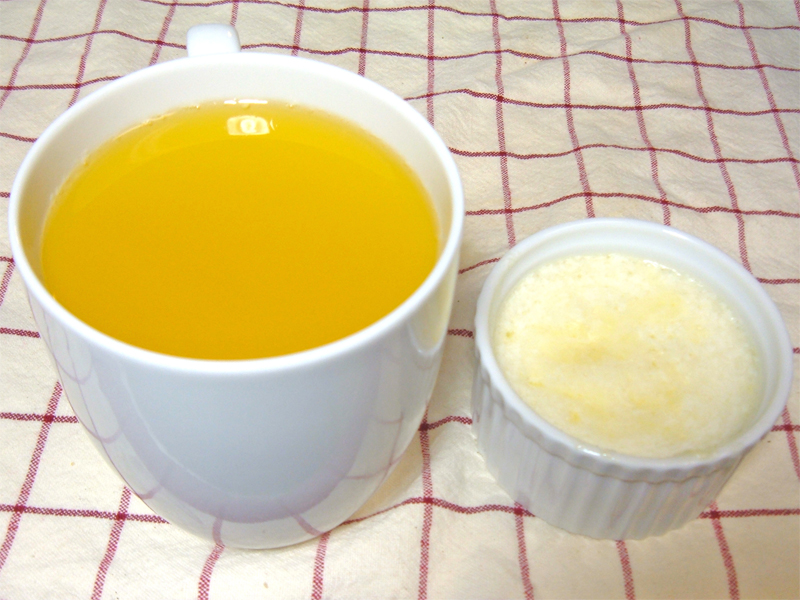
Clarified butter is ridiculously simple to prepare. I usually make a large batch, starting with 2 cups (about 452 grams) of unsalted butter, and refrigerate the liquid in empty, recycled containers of honey. To understand the process, recall the three relevant components of butter:
- water
- milk solids
- clarified butter
To obtain clarified butter, we must isolate these components. How well we accomplish this task will influence the clarity (and purity) of our product. The simplest and "dirtiest" method is to heat butter in a thick-bottomed pan over low heat until the three layers separate; skim off the foam and ladle off the clarified butter, leaving the small layer of water and heavy milk-solids at the bottom. Done. For almost everyone who cooks at home, this alone is sufficient.
Fussy chefs will occasionally simmer off the water until the butterfat just begins to fry. At that point, they’ll usually pour the mixture through a damp cheesecloth. The result is usually clearer and just a bit golden.