
Many Chile Red Chili -- In Your Face, Space Coyote!
December 22, 2009 by Tyler McHenryGuest article by Tyler
Chili is a dish made from chiles that is wonderful to eat when you are chilly.
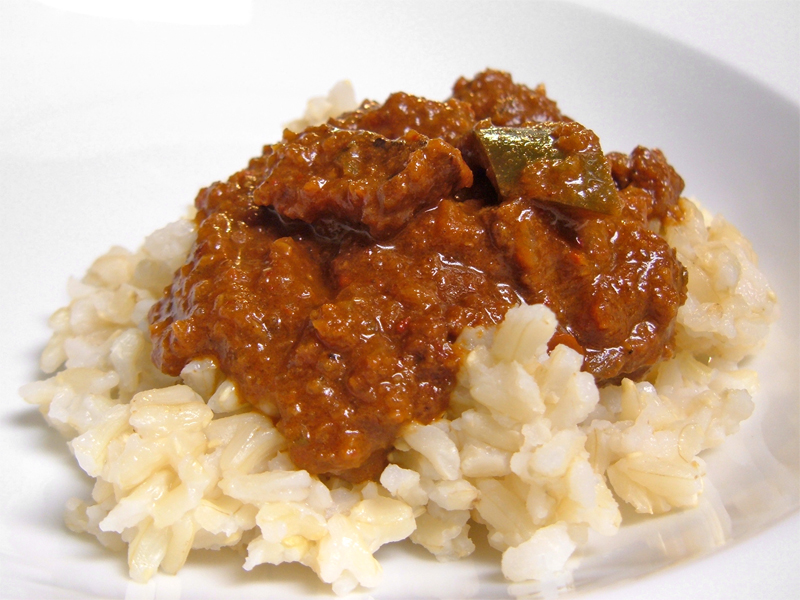
Chili is one of those dishes that nobody ever agrees on how to cook, so if you’ve ever cooked chili before you are guaranteed to hate this post and be very angry at me for all the mortal sins against southwestern gastronomy that I surely have committed in your eyes.
The reason nobody agrees how to cook it is because it is a dish of low origins. Originally, chili was a Mexican stew made from whatever meat was available, and heavily spiced with local hot chiles to hide the taste of the often spoiled meat. These days, thanks to the wonders of refrigeration, we no longer have to worry about covering up rancid flavors, but the spiciness of the chile peppers is still something that can be appreciated on its own merits.
While there are plenty of sorts of chilis that have come about since its humble origins in 19th century Mexico and Texas (chile verde, white chili, etc), I see varieties of the most popular form of chili, red chili, on a two-dimensional axis. There is the axis of beans and the axis of tomatoes.
The axis of beans runs from those who would rather eat their pet dog than chili with a single bean in it, to those (vegetarians, mainly) who forgo the meat entirely and eat chili composed only of beans. The axis of tomatoes, similarly, runs from those recipes in which tomatoes are forbidden, to those that are built on a base of tomato sauce. And yet somehow, magically, all of these things are still called chili.
Growing up in the northeast, quite far away from both Texas and Mexico, the sort of chili that I was familiar with had beans in combination with meat, and was heavily tomato flavored. Essentially, it was ground beef and kidney beans with some sautéed vegetables, mainly onions and bell peppers, bound together with tomato sauce and flavored with ancho chile powder, cumin, salt, pepper, and maybe a dash of cayenne pepper if someone was feeling adventurous.
There’s nothing necessarily wrong with this sort of chili, and in fact I found a reasonably good recipe for this that I have made several times (which I use as written, plus black beans). However, when Jenn and I set out to make a better chili, we realized something that should be fairly obvious:
The primary flavor of chili should be chiles.
There is a whole menagerie of different sorts of chile pods out there, most of which your average north-eastern chili-eater has never tasted. A chili dish is the perfect opportunity to taste all of these wonderful flavors, rather than tasting tomato and beans, overlaid with a monotonic note of ancho powder (which is what most generic “chile powder” usually is).
So we found a base recipe to start with that is free of beans, and while it contains tomatoes, doesn’t base itself on a tomato sauce. The main selling point is the abundance of different chile flavors in the recipe. Several kinds of fresh and dried chiles are called out below, but really this recipe can be used to mix and match fresh and dried chiles of any sorts you want to try.
The recipe is based on Bobby Flay’s Red Beef Chili recipe. I modified it in a couple of ways to suit my preferences and the availability of ingredients.
- I made it larger. This recipe is about one and a half times the quantity of Flay's, yielding around nine servings instead of six. I've made this in a double batch (yielding 12 servings) before as well.
- I made it hotter. This recipe includes more fresh chiles, and more chile powder than Flay calls for. It uses four dried chiles: ancho (common mild chile powder), cascabel (hot and sharp), guajillo (medium and sweet), and chipotle (medium and smoky).
- I made it thicker. Like almost all chili recipes I have seen, the original Red Beef Chili recipe calls for an absurd amount of water: 5 cups. If you use that high a ratio of water to dry ingredients, you've made soup, not chili. I don't understand why people seem to like thin, watery chili.
- I kicked out the sweetness.The original recipe called for maple syrup. I love sweets, but in most cases I prefer to have them after my meal in the form of pies and cookies. My preferred main courses are mainly savory.
Finally, I made some substitutions:
The original recipe called for chipotle puree, which I have used in previous incarnations of this dish. But this time I had powder on hand, not puree, so that was used instead.
It also called for New Mexico chile powder. These too I have used previously, but this time the grocery store was fresh out of dried New Mexico chiles. Instead, I substituted some dried guajillos that were left over from Jenn’s Mole Negro Oaxaqueño.
It called for pasilla chile powder, which I have just never been able to find. I do, however, have a strong liking for fresh poblano chiles, the fresh chile from which the dried ancho powder is made (note that these are sometimes erroneously sold under the name “pasilla”). They are a sturdy, relatively mild chile with an interesting smoky flavor. I replaced the pasilla powder with several fresh poblanos.
It called for Thai bird chiles. These are a little hotter than, but also smaller than, Serrano chiles, and I just so happened to have a small, rather pathetic serrano plant out on my balcony which had borne some small fruit, and was about on its way out for the year. I decided to make use of six of these very small serranos in place of the two Thai bird chiles that were called for.
Here’s how it ended up:
Ingredients
6 tablespoons olive oil, divided
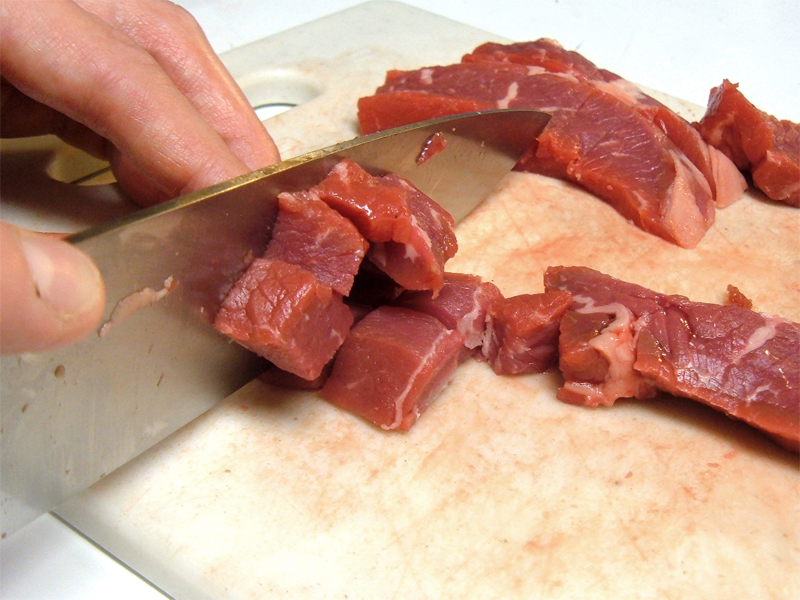
3 pounds top round beef, cut into ¼-½ inch cubes
salt
pepper
1½ tablespoons ground cumin
14½ ounces Guinness (or other stout beer)
3 tablespoons chopped semi-sweet chocolate
1½ large red onion, diced
6 cloves garlic, pressed
3 poblano (pasilla) chiles, diced, divided
6 small (or 2 large) serrano chiles, diced
2 medium jalapeño chiles, diced
1 habanero chile, diced
1½ tablespoons chipotle chile powder
1½ tablespoons ancho chile powder
1½ tablespoons cascabel chile powder
1½ tablespoons guajillo chile powder
1 cup home-made unsalted chicken stock
2 (16oz) cans petite diced tomatoes
Directions:
- Heat 4 Tbsp (¼ cup) of olive oil in a large dutch oven on medium heat. Add cubed beef, season with salt and pepper, and saute until almost completely browned. Then, add and stir in the ground cumin.
- Remove the beef from the dutch oven and reserve, including all juices.
- De-glaze the dutch oven with 14½ oz (that's one aluminum can's worth, or about one and a quarter glass bottles) of Guinness stout beer. When the Guinness has gotten hot, add the chopped semi-sweet chocolate. Let the beer-chocolate mixture simmer until it is almost entirely reduced, stirring occasionally.
- In the meantime, prepare your onion and fresh chiles. The chiles should be mostly de-seeded, although you should leave a few seeds if you like your chili hot, as I do; or, leave all of the seeds if you are a masochist.
- Dice two poblanos into chunks of a similar size to your beef, and add them to your reserved beef.
- Peel the garlic, and dice the red onion, the remaining poblano, and all of the jalapeño, serrano, and habanero. Give them all a medium dice, though you don't need to be overly precise or uniform since they are going to get pureed shortly. It is strongly suggested to wear latex gloves during this step, unless you want your fingers to feel like someone set them on fire for the next few hours.
- In a large saucepan, heat 2 Tbsp of olive oil and sauté the red onion with the garlic until the onion pieces are softened (about 2 minutes), then add the diced fresh chiles, and continue to sauté until the onions and chiles are mostly cooked (another 2-5 minutes).
- Then, add all remaining ingredients to the pot: all four chile powders, the diced tomatoes, and the chicken stock. Bring to a gentle boil four about 10 minutes, then remove from heat and puree in a food processor (or blender, or use an immersion blender if you have one).
- By this point, the Guinness-chocolate reduction in the dutch oven should be done. Combine everything (puree, reduction, reserved beef and poblanos) back into the dutch oven. Mix well, and simmer for at least an hour.
- Finally, add salt to taste. Note that there is no salt in the above recipe aside from that which was used while sautéing the beef, so the chili will likely need a substantial addition of salt at the end.
- Serve over brown rice.
The spice level was perfect. Hot enough to be interesting, but not so hot that you need to guzzle your drink and cry your eyes out during the whole meal. The chili flavors came through wonderfully, although some of the subtler flavors such as the beer and chocolate remain a bit hidden until the chili has sat in the fridge overnight. The texture was just right, and overall it was delicious, warming, and filling.

As for adjustments, this needs less tomato and more cumin. The tomato was not overpowering – the primary flavor was still most definitely that of the chiles – but it was too un-subtle for my liking. Further, I completely lost the cumin flavor in all the chili and tomato flavors, and I love cumin. An alternative to simply adding more would be to toast the whole cumin seeds before grinding to bring out a stronger flavor.
It may also do well with more meat. Every time I’ve made this recipe before, I’ve used lean ground beef instead of cubes. While the amount of meat is the same by weight, the dish just feels more sparsely populated with cubes as opposed to ground beef. I did, however, decide that I like the taste and texture of the cubed beef more than the ground.
A note on the chile powders: This recipe calls for at least four different chili powders. Chances are that you aren’t going to be able to find pre-powdered versions of all of these chiles. However, you probably can find dried whole chiles of each of these varieties, if not in your normal grocery store, then at least at your nearest Hispanic market.
There are two ways of going from a dried whole chile to something that you can incorporate into this dish. First, you can powder them yourself. A blender or food processor will not work for this. I tried. The best you can do with one of these is make flakes, which is not sufficient for chili. But a spice grinder (or coffee grinder) will do the trick. Jenn informs me that if using this method, you should grind the chiles in short bursts (so they do not heat up), and do so as soon as possible before you need to use them, so that the flavorful oils do not escape. Also, be careful not to open the grinder immediately after it stops spinning: you will essentially pepper-spray yourself.
If you do not have a spice grinder, or you do not have an extra coffee grinder and prefer not to find yourself with a surprise jalapeño latte the next morning, you can make paste. To do this, simply submerge the dried chiles in very hot water for 20-30 minutes, then remove and puree in a food processor or blender. You will likely need to add some of the (now chile-infused) water into the paste during the blending, or else it will just stick to the sides. The disadvantage of this method is that volumes of paste are not remotely comparable to volumes of powder due to the water content. You will have to use more paste than powder, and eyeball the quantity you need.
Of course, it goes without saying that whether you are making paste or powder, you will want to remove most of the seeds beforehand, unless you desperately want to force your brain out through your sinuses.