
Murghi Ni Curry (Ginger Chicken with Peanuts and Coconut)
January 16, 2010 by Tyler McHenryGuest article by Tyler
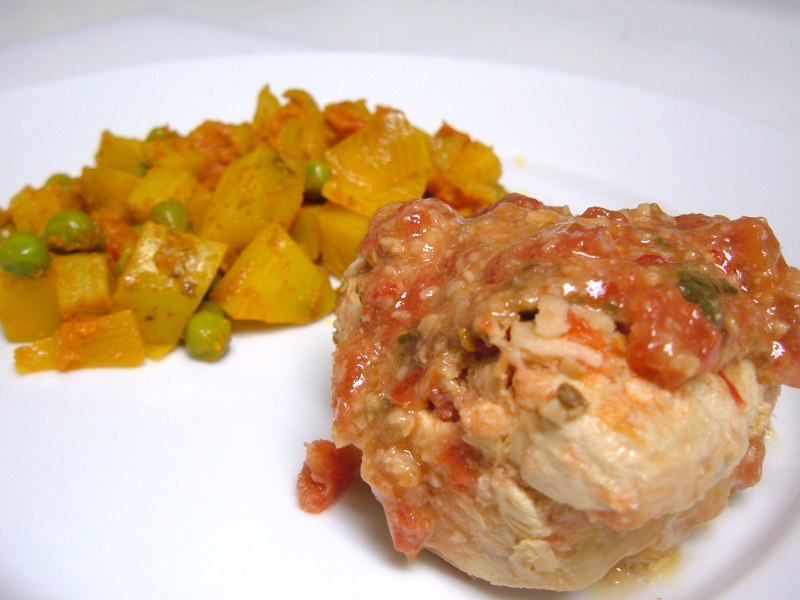
After putting together two fantastic feasts for Thanksgiving and Christmas, Jenn is starting off the new year by taking a short vacation to drive the darkspawn out of Ferelden. Meanwhile, I’m going to write up our first experiments with recipes from a book on curry that Jenn received for Christmas. You’ll have to excuse the sub-standard pictures — I don’t have quite the presentation skills that my wife does.
The book is 660 Curries by Raghavan Iyer. This book caught our eye because while we both enjoy Indian dishes, we’ve never really made too much of it ourselves beyond a very simple and very Americanized chicken curry, a rather botched attempt at Baingan Bharta, and the much more successful Yellow Dal Puree just recently.
We thought we’d start in somewhat familiar territory by focusing on chicken curries. Much like a good chili, what separates a boring curry from an interesting curry is the sauce. The Americanized curry-from-a-box approach, or the slightly more sophisticated “try to make something like curry-from-a-box without using a box” approach is to make a relatively simple tomato paste-based sauce, and to load it up with vaguely Indian-seeming spices, and pour it over a mish-mash of vegetables and small bits of chicken. The chicken curries in this book are much more authentic, and are without filler vegetables: just substantial pieces of chicken stewing in a complex, flavorful, savory sauce.
The first recipe we tried was Murghi Ni Curry. I have no idea what the literal translation of that is from Hindi, but it is anglicized as simply “Ginger Chicken with Peanuts and Coconut”. I’m a little wary of coconut. I tend to avoid dishes that contain any more than a touch of coconut milk, although I don’t mind coconut pieces or flakes. Fortunately, this dish called for flakes. And even more fortunately, I love peanuts.
Here is the recipe as we made it, which follows the book recipe fairly closely:
Ingredients
1 whole chicken (at least 4 pounds)
2 Tbsp ginger paste (see below)
1 Tbsp garlic paste (see below)
2 Tbsp canola oil
¼ cup raw peanuts (no skin)
1 Tbsp whole coriander seeds
5 dried cayenne peppers, stems removed
¼ cup dried coconut flakes
1 (14½ oz) can petite diced tomatoes
2 tsp kosher salt
handful of cilantro leaves, chopped
Directions:
- Begin re-hydrating your coconut. Cover the flakes in very hot water and let them sit for about twenty minutes or until soft, then drain the water.
- Prepare ginger and garlic pastes. These are very simple and exactly what they sound like. Peel and coarsely chop ginger and garlic (respectively), and then puree with some water using a blender or food processor. The ratio should be approximately ½ cup of water to each 8 oz of ginger or garlic. You can make these en mass and freeze them for later. Note that mixing your pureed garlic with tap water may cause it to turn blue after a little while if you have very fresh garlic and copper in your tap water. This is fine and it is still safe to eat.
- Remove the skin from and disassemble your chicken. You want to cut it into eight pieces: two legs, two thighs, and four half-breasts. We chose to omit the wings, but you could leave them attached to one of the breast halves if you wanted. Save carcass (and the neck) for making chicken stock. You do make your own chicken stock, right?
- Using the canola oil and a large hot skillet or dutch oven, sear your chicken pieces for about 3 minutes on each side until it begins to brown. If using cast iron, especially enameled cast iron, be sure to reduce or even eliminate the oil. Do not stack the chicken at this step. If you cannot fit all of your chicken the bottom of the pan at once, do it in batches.
- While the chicken is searing, toast your dried spices and nuts. Place the peanuts, cayenne peppers, and coriander in a frying pan over medium heat (cast iron works great here), and toast until the coriander darkens, the peanuts begin to brown, and the chiles begin to blacken. When they are finished toasting, remove them from the pan immediately and use a spice grinder to grind them into a fine powder.
- Add the spice powder, the re-hydrated coconut, and ¼ cup water to a blender or food processor and puree together.
- Remove the chicken from the pan and deglaze the pan with the can of diced tomatoes, juices included. Add 2 tsp of kosher salt to the tomatoes (Note that this volume is in terms of kosher salt. Do not use 2 tsp of table salt; that would be too much.)
- Coat the chicken pieces with the coconut-spice puree, and return to the pan. Reduce heat to medium-low, cover the pan, and cook until the chicken has reached a safe internal temperature of 165 F. This should take between twenty and forty minutes depending on how hot the pan is. If the tomato liquids do not cover the chicken, you should return to the pan to baste occasionally throughout the cooking process.
- Remove the fully-cooked chicken from the pan, and set aside. Cover to retain heat. Add the handful of chopped cilantro to the remaining sauce, return heat to medium-high, and reduce the sauce for 5-10 minutes or until it is sufficiently thick for you.
- Serve the chicken pieces, topped with a generous helping of sauce.
By itself, this recipe makes about four servings, but with a side-dish it can easily serve six.
This curry was utterly fantastic. It had just the right kick of spice, without being overpowering, and the flavors of the coriander, peanut, garlic, and ginger played very nicely together atop a not overly-sweet tomato base. It’s important here that the tomato flavor came from diced tomatoes, and not from tomato sauce or paste. Not only does that add texture, but it is also not overpowering and so does not taste like Indian spaghetti sauce.
There are a few modifications we will make next time, though. First, we used an enameled cast-iron dutch oven for the whole process, but we used the full 2 Tbsp of canola oil. This resulted in chicken that was not browned enough, and a sauce that had an oily feel to it. Second, it could use a little more salt. Not a lot; we both ended up adding just a sprinkling over our dishes, but it would probably be wise to increase the initial salt content to 3 tsp of kosher salt.
Finally, I might want to increase the peanut content next time, since I think that was the weakest of the flavors in the curry. As I mentioned before, I love peanuts. Our grocery store wasn’t carrying whole raw peanuts this week, only roasted peanuts, so I used lightly salted cocktail peanuts instead. We used the ¼ cup of peanuts required by this recipe, and then then other 2 ¾ cups in the can disappeared into my mouth over the course of two days. Mmmmm… peanuts.
Side Dish: Aloo Phujia
Our staple Indian side dish, if we’re not striving to be overly experimental with that part of the meal, is Aloo Phujia, a dish of heavily spiced potatoes, onion, tomatoes, and peas. Our recipe is based on this one from All Recipes.
Ingredients
1 large white onion, chopped
2 lbs yukon gold (yellow) potatoes
4 tsp kosher salt
2 tsp cayenne powder
2 tsp ground turmeric
1 tsp ground cumin
4 roma (plum) tomatoes
frozen peas
vegetable oil
Directions
- Wash the potatoes and cut into ½ inch cubes. Leave the skin on, and try to be as regular as possible about the size of the cubes so that all of the potatoes finish cooking at the same time. Boil the potato cubes until they are just slightly underdone, then let them drain thoroughly.
- While the potatoes are boiling, prepare the onion and the tomato by dicing into ½ inch pieces and cubes respectively.
- Once the potatoes are draining, sauté the onion over medium heat in a large skillet with the minimum amount of vegetable oil required to coat the skillet.
- When the onions are halfway done, add frozen peas and continue to sauté. I never measure the quantity of peas, but I imagine that I use about a cup.
- When the onions are three-quarters done, add the tomato cubes and continue to sauté.
- Finally, when the onions are just almost done, add the potato cubes (which should also be "almost done"), and the spices and the salt. Thoroughly mix everything together, cover the skillet, and cook until the potatoes and the onions are properly tender. You may need to add some extra salt at the end. Potatoes are finicky like that.
This makes about 12 servings as a side dish. The turmeric combined with the yellow potatoes causes the dish to come out with a vibrant yellow-orange color, and the cayenne powder makes it very hot. Unlike the “pleasant kick” of spice in the curry recipe above, this recipe is one that will make your nose run and your eyes water, although it doesn’t go so far that it is unpleasant to eat or that it mutes the taste of itself or other foods.