
Badam Murghi (Yogurt-Almond Chicken with a Spinach Sauce)
January 18, 2010 by Tyler McHenryGuest Article by Tyler
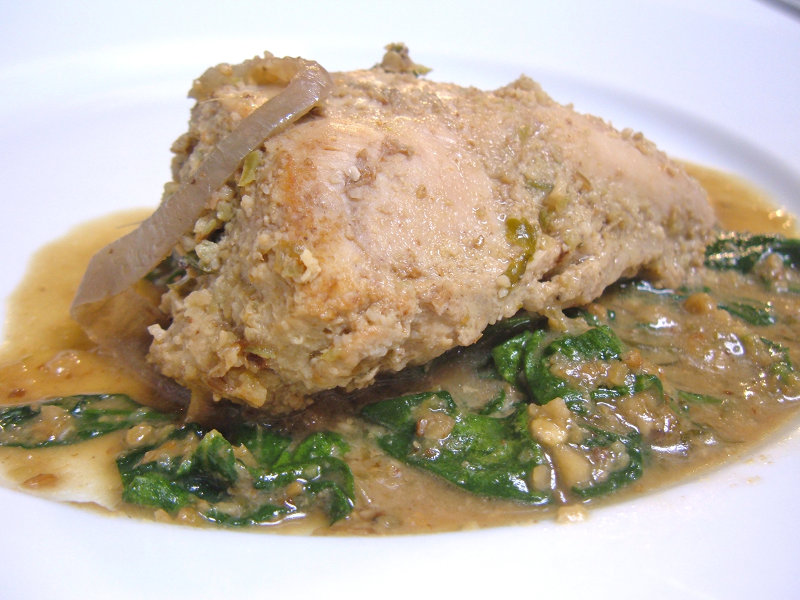
After successfully preparing a delicious dish of Murghi Ni Curry, our second foray into the book 660 Curries by Raghavan Iyer was Badam Murghi. Again, I can only guess as to what this might literally translate to, but it is anglicized as “Yogurt-Almond Chicken with a Spinach Sauce”. If you haven’t read the article on the Murghi Ni Curry, take a minute to do so, as I will be making numerous comparisons between the two.
This recipe differs in a few ways from the Murghi Ni Curry. While both are recipes for a whole cut-up chicken, braised in a spicy, savory sauce, this recipe requires that the chicken be marinated first, with the marinade later forming part of the sauce. The most fundamental difference between the two sauces, however, is that the sauce for the Murghi Ni Curry was tomato-based, while the sauce for this Badam Murghi is yogurt-based.
Aside from the marinading step, the preparation of the two dishes is nearly identical. The chicken is cut up and seared, then the pan used for searing is de-glazed. Then the chicken is re-introduced to the pan, and it is covered and braised. Finally, the chicken is removed and the sauce is reduced and served over the chicken. As a result, the textures of the two dishes are very similar, however the flavors are very different despite both being distinctly Indian.
Ingredients
1 whole chicken (at least 4 pounds)
[for the marinade]
1 cup plain yogurt
¼ cup blanched almonds
1 ½ Tbsp ginger paste
1 ½ Tbsp garlic paste
1 Tbsp whole coriander seeds
1 tsp whole cumin seeds
1 tsp kosher salt
½ tsp green cardamom pods
½ tsp whole cloves
7 fresh Serrano (or Thai) chiles, stems removed
handful of cilantro leaves, chopped
[not included in the marinade]
1 medium red onion
4 bay leaves
6 oz pre-washed baby spinach leaves
Up to 4 Tbsp vegetable oil or non-stick cooking spray
Directions
- Prepare the marinade at least two hours before cooking, but preferably the night before, so the chicken pieces can marinade overnight. Start by grinding all of the whole spices (including the salt) together with the blanched almonds in a spice grinder until they are finely ground.
- Prepare ginger and garlic pastes. This is the same as what was used for the Murghi Ni Curry; they are very simple and exactly what they sound like. Peel and coarsely chop ginger and garlic (respectively), and then puree with some water using a blender or food processor. The ratio should be approximately ½ cup of water to each 8 oz of ginger or garlic. You can make these en mass and freeze them for later. Note that mixing your pureed garlic with tap water may cause it to turn blue after a little while if you have very fresh garlic and copper in your tap water. This is fine and it is still safe to eat.
- Combine the plain yogurt, the ground spices, the garlic and ginger pastes, the cilantro, and the fresh chiles in a food processor or blender, and pulverize them together until it is the consistency of a puree. You may need to cut the chiles into chunks beforehand, depending on the size of the peppers and the size of your food processor, but do not remove the seeds or veins (do remove the stems). This is the complete marinade.
- Remove the skin from and disassemble your chicken. Again, this is the same as for the previous curry. You want to cut it into eight pieces: two legs, two thighs, and four half-breasts. We chose to omit the wings, but you could leave them attached to one of the breast halves if you wanted.
- Place the chicken pieces in a large plastic bag and thoroughly coat with the marinade. Seal the bag and leave it in the refrigerator for at least one hour or preferably overnight.
- When ready to cook, first slice the red onion in half and then into thin strips, producing half rounds. Add the onion strips and the bay leaves to a large skillet or dutch oven and sauté over medium-high heat until slightly browned around the edges. We used an enamel cast iron dutch oven, which is naturally non-stick and so used just a bit of non-stick cooking spray, but if you are using a normal skillet, you should add up to 2 Tbsp of vegetable oil at this step for lubrication. When done, remove and set aside the onion and bay leaves.
- Remove the chicken from the marinade, reserving the marinade. It's alright if some of the marinade clings to the chicken, but it shouldn't still be dripping with it. Sear the chicken pieces in the same skillet or dutch oven that you used for the onions, for three minutes on each side until lightly browned. Again, use a bit of non-stick cooking spray, or if not using something naturally non-stick, up to 2 Tbsp of vegetable oil to facilitate this. Do not stack the chicken; if not all of it can contact the cooking surface at once, work in batches. When done, remove and set aside the chicken pieces.
- Reduce the skillet or dutch oven's heat to medium-low, and de-glaze with the reserved marinade. Return the chicken and the onions to the vessel, cover, and allow to cook until the chicken has reached a safe internal temperature of 165 F (approximately 20-40 minutes).
- When the chicken is fully cooked, remove the chicken pieces and set aside, covered to retain heat. Return the stove to medium-high heat and reduce the sauce for 5-10 minutes or until it is as thick as you desire.
- Finally, add the 6 oz of baby spinach leaves to the sauce, stir in, and cook until wilted. This should only take a minute or two. Serve generous portions of sauce over the chicken.
Like the previous curry, this serves 4 if eaten alone, or 6 if eaten with a side dish. We again used the leftover Aloo Phujia described in the previous article as a side dish. You will note that that side serves 12, while each of these curries serve 6.
This recipe was made with a few deviations from the recipe presented in the book. The main difference is that the book recipe calls for 6 cloves of garlic and 6 (1 ½ inch) slices of ginger. Instead, we decided to take advantage of some the garlic and ginger purees that we made in excess quantity for the previous curry. This necessitated a judgment call on how much paste would constitute an equivalent quantity, but I think it turned out to be about right.
The first thing that struck me about this curry was how shockingly mild it was given the quantity of hot peppers, complete with seeds, that were included in it. There was only the slightest hint of any heat whatsoever in the sauce. Not that that was a detriment to the dish; it was just surprising. What was also surprising was that the sauce turned out brown. The marinade, when you first prepare it, is a pale green owing to the white of the yogurt combined with the green of the chiles and the cilantro. However, when it is used to de-glaze and then cooks with the meat, it turns a rich, delicious-looking gravy-brown color.
The sauce was creamy-tasting and full of savory spice, and the chicken was more tender from having been marinated overnight. The wilted spinach leaves offered an interesting burst of a texture and flavor that contrasted well with both the sauce and the chicken. Further, we failed to make the same mistake twice with the oil. This time, we used no liquid oil at all in the cooking process (only non-stick cooking spray), instead relying on the naturally non-stick surface of our dutch oven, and the sauce therefore did not come out with an oily texture.
There were, in my opinion, some issues with this dish though. First, the sauce ended up a bit thin. I think this is attributable to two things: first, the water released by the spinach, and second the sort of yogurt I used. The spinach water issue could be solved by reducing the sauce to a point where it is thicker than would normally be desired before adding the spinach. As for the yogurt, we used a fat-free Greek yogurt. When shopping for light or fat-free yogurts, it is hard to avoid those that are loaded up with fillers and corn starch, but we found one that was a real, honest, no-nonsense yogurt. Still, the fact that it was fat-free probably contributed to the thinning of the sauce. Next time we prepare this, we will probably try with a full-fat yogurt, or at least only a light yogurt.
Secondly, I thought that the spices in this dish did not go together as well as the spices in the previous curry. I could taste almost all of the spices individually, but they did not seem to complement each other as well as before. For example, I would take a bite that tasted strongly of green cardamom, followed by one that tasted strongly of ginger, but I would not get a bite in which cardamom and ginger would produce a greater flavor together, as is usually the goal when combining spices for cooking. This may just have been me, though, since Jenn didn’t have the same complaint. She thought that the green cardamom flavor was almost lost, but that despite the flavor not being unusual (like the combination of peanut and coconut), it was on the whole more well-balanced between sweet and savory than the Murghi Ni.
One of Jenn’s suggestions for future improvement of this dish was to chop the baby spinach leaves before adding them to the sauce, since despite their very positive contribution to flavor, the sharp difference in texture between the smooth sauce and the hunks of spinach leaf made it a bit awkward to get all of the parts of the dish in your mouth at once. Along the same lines, it might be advisable to cut up the chicken pieces into yet smaller (but still fairly sizable) chunks either before or after the braising step to reduce the distraction of having to manage large chunks of meat while trying to to consume the dish, especially with the bone-in pieces.