
Gourmet Lasagna
May 2, 2010 by The swedish meatball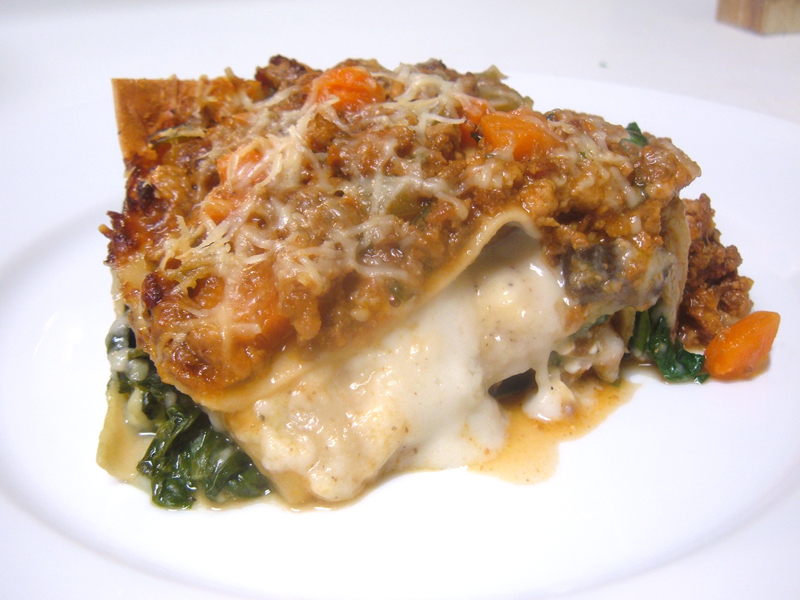
The weather in west Torrance is lovely at this time of year, if somewhat varied and unpredictable. Spring rains are abating rapidly, but gusty coastal winds and bouts of cloud cover can result in unseasonably cool temperatures (especially indoors, with all the breeze and none of the sun). Gradually, however, the days are warming. Temperatures aren’t likely to peak until the month of August, but they are expected to rise into the high 70s or low 80s by July. So Tyler and I are finishing the end of Spring cuisine with a warm, hearty meal—the likes of which we’ll probably not revisit again until the end of this year or the beginning of the next.
My remarks on lasagna will be broken up to parallel the form of the original post (at the bottom of this page). At some vague point in the future, I will probably consolidate the article into one edited post.
Bolognese Sauce
"Bolognese" sauce might be a misnomer for what’s actually described in the recipe ingredients. I use a large ratio of vegetables to meat, much larger than I would use for a traditional bolognese sauce. My reasons (thus far unexplained) are twofold:
- Though I don't advertise the fact readily (because certain individuals might be frightened), this lasagna isn't actually the pure meat lasagna it's advertised to be. Most meat lovers actually don't notice, but I sneak in quite a bit of vegetable goodness. That's because I like vegetables. Everyone else should like them too.
- The lengthy cooking time for the "bolognese" sauce flattens the taste of vegetables. I don't mind terribly because the vegetables should play second to the meat. The result is mellow, rich, and heavy. If you prefer light, vibrant, acidic, and fresh, this recipe is not for you.
In my opinion, the original described procedure isn’t the optimal way to create a bolognese sauce for lasagna, but it is probably the simplest to explain. There are several alternatives in the process to consider, some of which I pursued in this Spring’s batch:
- Use less diced vegetable (onion, celery, carrot), but sweat the vegetables separately from the meat and reserve. During the last half hour of simmering, add the vegetables to the pot with the meat. The reduced cooking time should prevent the vegetable flavors from flattening, and the reduced quantity should save materials and prevent the vegetable flavors from overwhelming the meat.
- Brown the meat and reserve. Then deglaze the pan with wine, scrape up the brown bits (fond), and add the resulting mixture to your sauce. Accomplishing this task is a nontrivial effort. Crowd the pan with too much meat and you'll end up with a bunch of liquid (forget browning). Use a pan with insufficient evaporation (say, a dutch oven) and you'll likely end up with liquid in the pan despite all herculean efforts. Four pounds of meat will require you to brown in batches, deglaze in batches, drain the meat over a colander, and reserve the resulting liquid, skimmed of whatever fat floats to the top. Return both the meat and the liquid to the sauce together.
- Fry the tomato paste or utilize tomato concasse. Frying would remove some of the acidity of the tomato (a technique seen in the preparation of brown stocks), while tomato concasse would provide a spot of freshness and vibrancy.
- Use less wine. I admittedly use an usually hefty quantity of wine, which I suppose is shocking to a traditionalist. However, during the hours long simmering time, a large portion of the alcohol will evaporate and the flavors will mellow. If you wish to use less wine, I recommend adding no less than a ½ cup during the last hour of cooking.
- Enrich the flavor of the sauce with beef/veal stock or neck bones. Perfectionists will want to prepare the stock in advance, but simmering the neck bones (with the sauce) for several hours should suffice. I would recommend browning the neck bones prior to cooking.
122 grams (3 slices) cured bacon
458 grams fresh celery, diced
445 grams fresh Maui onion, diced
472 grams fresh carrot, diced
1006 grams raw ground sirloin
902 grams raw ground pork
462 grams ground veal
4 large beef neck bones
1 cup pinot noir
822 grams tomato puree
salt and pepper, to taste
fresh oregano and parsley (chopped), to taste
There are several observations to be made about this list.
- The quantities of pork, beef, and veal are unequal. That's not what I would ordinarily recommend, but today's sale was for freshly ground sirloin and (for reasons mysterious to me) most of the veal wasn't very good. Isn't veal supposed to be best in spring? Oh well. To boost the flavor, I tossed in a few neck bones.
- There is less onion here than in the previous batch. Two onions was a bit much last time, so I decided to be gentle and take advantage of the Maui onions at farmer's market.
- Tomato puree is used in place of tomato paste. Not only did I have less paste on hand than I would have liked, but browning the meat reduced the availability of liquid in the pot. The liquid in the puree resolved this problem quite adequately.
I won’t bother going over the directions in detail, but if you have any questions, feel free to inquire. Below is a brief summary of the procedure for the bolognese sauce. I highly recommend preparing this sauce the day before you plan to assemble the lasagna, as any attempt to cram the entire recipe into one day may induce stress (especially if you have other plans).
- Fry the bacon. Remove the bacon, crumble, and reserve.
- Cook the onion, celery, and carrot in the bacon fat, seasoning with salt and pepper. Set aside and reserve.
- Brown the meat, seasoning while you cook, and deglaze as described earlier. Reserve the crumbled ground beef, pork, and veal, along with any liquid (deglazing wine and meat drippings). Do not forget to brown the neck bones!
- Place the vegetables, the bacon, the neck bones, the ground meat, tomato puree, and reserved liquid in a large stockpot (preferably in this order). Simmer for at least four to six hours. Skim off any residual fat which floats to the surface.
- Turn off the heat. Remove the neck bones, adjust the amount of salt and pepper to taste, and add the chopped herbs. Stir. Maintain at warm if you plan to use immediately; otherwise, cool the sauce quickly and store in the refrigerator.
Bechamel Sauce
In the original post, I was visiting my in-laws and my handy jar of pre-prepared clarified butter was two thousand miles away. But today my fridge and its contents were at my disposal—hence the change of ingredients, which produced a much cleaner roux and a decidedly smoother sauce.
4 Tbsps clarified butter*
7 Tbsps all purpose flour*
3 cups nonfat milk
46 grams parmigiano reggiano
nutmeg, salt, and pepper to taste
*Approximately 1:1 in weight, as per my last observations on roux.
You will also note a reduction in the quantity of milk added. I’m not exactly certain why the roux accepted less milk, but follow the directions from the previous post and use your judgement. If the sauce appears too thick, add more. Just remember two important points: (1) the cheese will also thicken the sauce (2) never dump the entire quantity of milk into the roux all at once. Failing to gradually add the milk will result in a lumpy sauce, which is Bad News.
"Ricotta" Cheese Mixture
There was a slight mix-up in this week’s grocery list, and rather than 16 oz ricotta cheese, my grocery bag contained 32 oz cottage cheese. I suspect the thought processes which led to the error went something like this:
- Jenn gained 5 lbs due to exercise. How, you ask? Several years ago, Jenn cut carbohydrates down to 50% of her caloric intake and lost a ton of weight. But now Jenn is running 5x a week, and apparently runners who don't eat enough carbs can GAIN weight. Jenn is really not sure what to think of this oddity, because while carbs are awesome, more carbs means less protein. And Jenn really likes her protein. Oh, irony, for shame!
- Jenn associates cottage cheese with weight loss and yum. Maybe because one serving of cottage cheese contains 14g protein? Mmmm protein.
- Jenn sees the 16 oz tub of cottage cheese and thinks, "For two trays of lasagna? Nope!"
- Jenn buys 32 oz cottage cheese.
I’m not terribly heartbroken about the kerfuffle because cottage cheese is awesome. Also, it’s practically common to see cottage cheese these days; if you can make cottage cheese enchiladas, you can make cottage cheese lasagna. (And, yes, you can SO make cottage cheese enchiladas. Don’t let anyone tell you otherwise!)
To complete the saga of I’m-working-by-the-seat-of-my-pants, I completely rewrote this layer of the lasagna. The ingredients are now as follows:
32 oz lowfat (2%) cottage cheese*
1145 grams fresh spinach, cooked, dried, and chopped**
fresh parsley, chopped
salt and pepper to taste
*Nonfat cottage cheese contains some weird thickeners, preservatives, and the scarily androgynous "food starch," so I just go for the lowfat cottage cheese. The ingredients seem so much more friendly.
**As per the instructions in the previous post.
To prepare, simply mix all the ingredients thoroughly. Done!
Homemade Whole Wheat Lasagna Noodles
No, "homemade" is not a typo. Tyler and I made fresh, wide pasta noodles, dried them on a rack, briefly immersed them in hot water to soften them, and then used them in the lasagna as-is. Simply put: delicious! The homemade whole wheat noodles are so much more tender than the dried, boxed stuff in your grocery store. And our Imperia pasta machine is just a total badass; if the crank handle locked into place, I would even call this contraption perfect.
Tyler did most of the prep work for this section, and he’ll probably leave a comment later with his own insights/tips about lasagna noodles. But here’s a breakdown of the ingredients:
3 cups white whole wheat bread (hard) flour
3 large eggs
10 grams olive oil
3 pinches of salt
Enough water to obtain the appropriate dough consistency. See our previous post on spinach noodles for more information.
This quantity of ingredients made more noodles than we could use. If I were to estimate, I’d say we had about eight leftover noodles and each tray of lasagna used only four noodles.
Optional Ingredients
The spinach was incorporated into the ricotta cottage cheese layer; as previously discussed in the last post, you will need to remove most of the moisture from the spinach before chopping and incorporating into the lasagna.
The directions for the eggplant are nearly identical. Cut into ¼-½ inch slices (three eighths of an inch for the precise), dehydrate, and bake. Yes, bake. More specifically, bake at 350°F for 10 minutes on a very lightly oiled sheet pan. Baking produces a drier product, which (in this case) is very desirable.
Follow prior instructions for the mushrooms.
Finishing
I wanted to pair the bechamel sauce with the vegetarian elements of the lasagna, so the layering is altered accordingly: bolognese sauce, noodles, spinach-cottage cheese mixture, eggplant, mushrooms, bechamel, romano cheese, noodles, bolognese sauce, and a top layer of romano and Parmesan cheeses.
After that, the cooking process is exactly the same as before. Be sure to heed my previous admonitions: each layer should cover every single speck of visible surface, and ideally the noodles should overlap to help "hold together" the lasagna.
Overall Remarks
Done properly, this lasagna is superb. It’s difficult to find points to complain about, as the flavors are so well developed and the outcome matches the target profile nearly to perfection. I’d like to see a larger proportion of noodles, but that’s pretty difficult given the limited depth of most casserole pans. Otherwise, I’m very satisfied with ratio of meat:vegetables:cheese. Sometimes traditional lasagnas will pile on globs of cheese—a horrible event for both the lasagna and your arteries, in my opinion.
That’s not to say that my rendition of lasagna is any bastion of health and nutrition. When I say "gourmet" lasagna, I mean all-guns-are-out, and we’re not leaving off the bacon (literally). Tyler and I estimated the nutrition info for a large slice, approximately one-eighth of the casserole pan:
Calories: 540. Total Fat: 27g. Saturated Fat: 12g. Cholesterol: 133 mg. Total Carbohydrate: 32g. Fiber: 6g. Protein: 39g.
Now that’s a hefty lasagna! On the plus side, fat, protein, and carbohydrates are pretty well balanced. Also, there’s probably less fat in the lasagna than what we estimated, but that’s because I skimmed off a good amount of fat in the bolognese sauce. Unfortunately, it’s impossible to estimate the impact of such a subjective effort, or even tell what kind of fat was lost during the process. We’ll just have to assume the worst case scenario: 27g total fat and 12g saturated fat. Twelve grams of saturated fat is nothing to wink at, as that’s 2g more than my usual daily intake of saturated fat for an entire day!
To enjoy this delicious goodness without fighting the battle of the bulge, I recommend moderation. I usually eat half a serving of lasagna together with fresh (or lightly steamed) veggies and a whole grain bread. Dessert is okay, but stick with something light, like fruit. Mmmm fruit…
Original Post: September 20, 2009
Okay, for starters, there should be a picture here. I started chopping vegetables for the lasagna at about 9 a.m. and finished the lasagna, two different kinds of chicken, and a loaf of bread at least 8 hrs later; after that, I couldn’t be arsed to get the camera out. So one day there will be a picture but today is not that day.
Lasagna has no one recipe, as there is practically an infinite variation in ingredients depending on taste. I can’t even find a reliable internet source for a history of lasagna, although there is some amusing reference to ancient Greek chamber pots. Personally, I prefer red lasagnas to white; moreover, I like my lasagna stuffed with meats, a variety of cheeses, and at least two or three kinds of vegetables. Refining this definition of a “good” lasagna, I would say the bedrock of lasagna is a bolognese sauce. A great bolognese sauce will forgive many other mistakes. A poor red sauce, say one with too much tomato, will overpower the flavors of the cheeses and meat with acidity; in that case, why not simply eat Americanized spaghetti sauce with noodles? Lasagna is lasagna, and should be treated as a separate dish, not just another convenient way to eat spaghetti sauce. Furthermore, if you really want to make a stellar lasagna, I can think of no better addition than a wonderful nutmeg-spiced bechamel sauce. Bechamel, prepared properly, acquires the delicate sweetness of milk and tastes wonderful in lasagna.
The following recipe makes two casserole dishes of lasagna.
Bolognese Sauce
4.0 lbs mixed ground meat, equal parts veal, beef, and pork
3-4 thick-cut slices bacon, roughly chopped
olive oil
butter
1 bag baby carrots, sliced
2 white onions, chopped
6-8 stalks celery (including leaves), chopped
fresh Italian parsley, chopped
fresh oregano, chopped
1.5 (12 oz) cans tomato paste
1-2 cups pinot noir or another wine
salt
fresh ground black pepper
- Heat a large stockpot over medium-high heat. Add enough olive oil and butter to cover the bottom of the pot.
- Fry the bacon until crisp, then remove to a paper-towel lined plate with a slotted spoon. If you like, you can crumble the bacon and add it back to the pot in Step 4.
- As soon as the bacon is out, add the onion, celery, carrot, 1 tsp salt, and pepper to taste. Cook for 2-5 minutes or until the sweating releases liquid into the pot.
- Add the ground meats and mix well. Add as much wine as desired or needed. Simmer until the meat is no longer pink.
- Add tomato paste and season with salt and pepper to taste. (I added another 1 tsp of salt.) For a well developed flavor, cover the pot and simmer the contents for several hours. Then stir in the chopped oregano and parsley and reserve the sauce.
Bechamel Sauce
4 cups nonfat milk
5 Tbsps unsalted butter
4 Tbsps flour
nutmeg
freshly ground black or white (preferred) pepper
about ? cups finely grated parmesan cheese
salt
- Scald the milk in a sauce pan. If possible, have another person stir the milk constantly and keep it hot while you prepare the roux.
- Melt the butter in a separate saucepan over medium heat. When the butter is completed melted, the foam-like solids should float to the top. Skim off the solids with a spoon.
- Add all the flour at once and begin whisking immediately. After several minutes the roux should turn a sandy golden color.
- Add one cup of the scalded milk to the roux and whisk until the mixture is smooth. Repeat until all the milk is incorporated. Then add the parmesan cheese and season with nutmeg, salt, and pepper. Reserve.
16 oz part-skim ricotta cheese
1 large egg
½ tsps salt
fresh chopped parsley
Combine all the ingredients and mix until fully incorporated. Reserve.
Whole Wheat Lasagna Noodles
2 boxes Ronzoni Healthy Harvest Whole Wheat Blend Lasagna*
olive oil
* I used all of the first box and about 8 noodles from the second box.
To prepare the lasagna noodles: fill a stockpot just a little more than half way with water, cover, and bring to a boil. Add olive oil. Gently add the noodles to the stockpot and cook for about 10 minutes uncovered. Dump the noodles into a colander. Briskly rinse with cold water until cool enough to handle. Immediately lay out the noodles on a sheet of wax paper to minimize sticking. Reserve.
If you have difficulty fitting the noodles into the pot, place one end of the noodle into the boiling hot water for a few seconds or until you can bend the noodle without breaking it.
Optional Ingredients per One Casserole Dish
1 bag spinach
1 medium American eggplant
2 boxes brown mushrooms or baby bellas
- Slice the eggplant into rounds ? inch thick. Salt and pepper both sides. Then lay the slices on a baking tray lined with paper towels. The salt will draw the excess moisture out of the eggplant, and the paper towel will absorb the liquid. (You may need to blot the slices on top once or twice.) After about 20-30 minutes, lightly saute the eggplant until tender but not mushy. Reserve.
- Saute the spinach until wilted. Drain the excess liquid and use paper towel to absorb as much of the liquid as possible. Then chop the spinach. (Biting into whole spinach leaves can be somewhat annoying in lasagna as the fibrous texture makes chewing difficult.) Reserve.
- Slice the mushrooms and saute. Allow the mushrooms to cool for 10 minutes or until all the liquid seeps out. Drain the liquid and reserve the mushrooms.
Finishing
Layer the lasagna accordingly: bolognese sauce, noodles, ricotta, spinach, eggplant, mushrooms, shredded mozzarella, shredded parmesan, bolognese sauce, noodles, bechamel sauce, spinach, eggplant, mushrooms, shredded mozzarella, shredded parmesan, etc, etc. Freeze one casserole as-is for a future meal. Bake the other casserole covered for 20 minutes and then uncovered for another 20 minutes. Allow the lasagna to cool for at least 15 minutes. Serve.
NB: I begin layering with the bolognese sauce on the bottom simply to prevent the noodles from burning. Also, when applying the noodles, be sure to overlap your noodles slightly and cover the exposed surface area completely; such precautions will ensure the lasagna holds together as much as possible.